Mammalian Activin E enzyme-linked immunoassay kit (one step)
| Specification | 96 Test |
|---|---|
| Sensitivity | 0.06 ng/ml (10 μl) |
| Standard Curve Range | 3.91~250 ng/ml |
| Standard Curve Gradient | 7 Points |
| Number of Incubations | 1 |
| Detectable sample | serum, plasma |
| Sample Volume | 10 μl |
| Type | Fully Ready-to-Use |
| Operation Duration | 60 min |
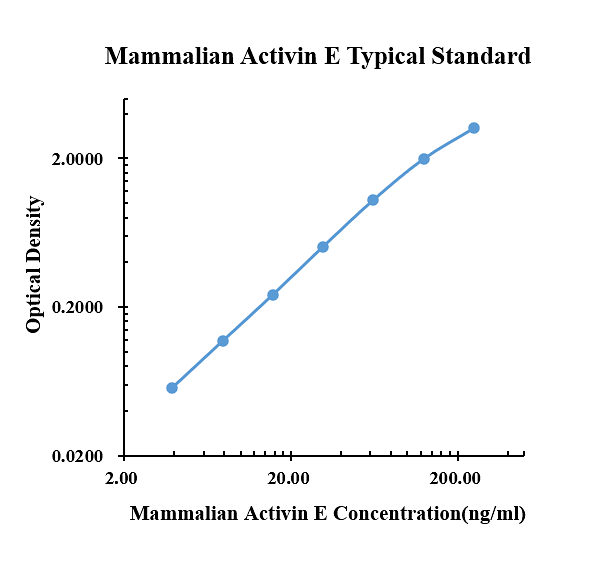
| ng/ml | O.D. | Average | Corrected | |
|---|---|---|---|---|
| 0.00 | 0.0073 | 0.0065 | 0.0069 | |
| 3.91 | 0.0656 | 0.0629 | 0.0643 | 0.0574 |
| 7.81 | 0.1209 | 0.1289 | 0.1249 | 0.1180 |
| 15.63 | 0.2501 | 0.2472 | 0.2487 | 0.2418 |
| 31.25 | 0.5334 | 0.4981 | 0.5158 | 0.5089 |
| 62.50 | 1.0980 | 1.0110 | 1.0545 | 1.0476 |
| 125.00 | 2.0750 | 1.8970 | 1.9860 | 1.9791 |
| 250.00 | 3.2990 | 3.0870 | 3.1930 | 3.1861 |
Precision
| Intra-assay Precision | Inter-assay Precision | |||||
| Sample Number | S1 | S2 | S3 | S1 | S2 | S3 |
| 22 | 22 | 22 | 6 | 6 | 6 | |
| Average(ng/ml) | 3.4 | 15.1 | 45.8 | 4.2 | 20.0 | 53.8 |
| Standard Deviation | 0.1 | 0.6 | 2.3 | 0.2 | 0.6 | 1.3 |
| Coefficient of Variation(%) | 2.6 | 3.7 | 4.9 | 4.7 | 3.2 | 2.4 |
Intra-assay Precision (Precision within an assay) Three samples of known concentration were tested Twenty-two times on one plate to assess intra-assay precision.
Inter-assay Precision (Precision between assays) Three samples of known concentration were tested six times on one plate to assess intra-assay precision.
Spike Recovery
The spike recovery was evaluated by spiking 3 levels of Mammalian Activin E into health mammal serum sample. The un-spiked serum was used as blank in this experiment.
The recovery ranged from 80% to 119% with an overall mean recovery of 96%.
Sample Values
| Sample Matrix | Sample Evaluated | Range (ng/ml) | Detectable (%) | Mean of Detectable (ng/ml) |
|---|---|---|---|---|
| Human Serum | 30 | 3.22-282.54 | 100 | 30.90 |
| Mouse Serum | 30 | 6.54-28.08 | 100 | 13.48 |
| Rat Serum | 30 | 3.39-149.33 | 100 | 31.78 |
| Monkey Serum | 2 | 9.74-10.17 | 100 | 9.95 |
Serum/Plasma – samples from apparently healthy mammals were evaluated for the presence of Activin E in this assay.
Product Data Sheet
Background: Activin E
Activin E, encoded by the INHBE gene, is a liver-enriched member of the transforming growth factor-beta (TGF-beta ) superfamily and functions as a hepatokine involved in systemic energy homeostasis. Structurally, it is a disulfide-linked homodimer of mature inhibin beta E subunits, sharing the conserved cystine-knot motif characteristic of TGF-beta ligands, which facilitates receptor binding and downstream signaling activation. Activin E signals through the type I receptor ALK7 (ACVR1C), activating the SMAD2/3 pathway and repressing PPARG target genes in adipose tissue. This signaling cascade suppresses beta -adrenergic-induced lipolysis, thereby promoting lipid retention in white adipose tissue and preventing excessive hepatic lipid influx during metabolic stress such as fasting. In murine models, mRNA knocked down results in increased fat oxidation, reduced adiposity, and improved metabolic profiles under high-fat diet conditions. Conversely, hepatic overexpression of INHBE leads to visceral fat accumulation and adipocyte hypertrophy, indicating a maladaptive role in obesity . Rare loss-of-function variants in human INHBE are associated with favorable fat distribution and reduced risk of type 2 diabetes, highlighting its clinical relevance. Expression of INHBE is upregulated by ATF4 during endoplasmic reticulum stress, linking it to nutrient sensing and adaptive metabolic responses. These findings underscore the potential of recombinant Activin E as a therapeutic target for metabolic disorders such as nonalcoholic fatty liver disease (NAFLD) and obesity.