Human CXCL5/ENA-78 enzyme-linked immunoassay kit
| Specification | 96 Test |
|---|---|
| Sensitivity | 0.29 pg/ml (50 μl);2.99 pg/ml (10 μl); |
| Standard Curve Range | 20.48~5000 pg/ml |
| Standard Curve Gradient | 7 Points |
| Number of Incubations | 2 |
| Detectable sample | Liquid phase sample of soluble substances. For example: serum, plasma, cell culture supernatant, tissue grinding liquid, etc. |
| Sample Volume | 50 μl/10 μl |
| Type | Fully Ready-to-Use |
| Operation Duration | 120min |
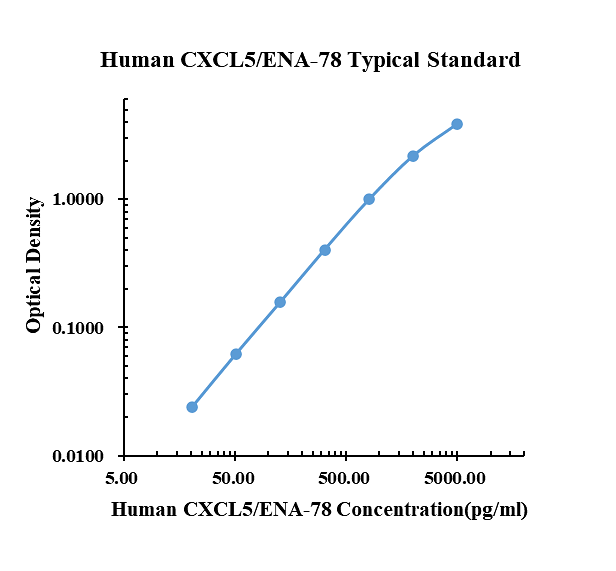
| pg/ml | O.D. | Average | Corrected | |
|---|---|---|---|---|
| 0.00 | 0.0134 | 0.0136 | 0.0135 | |
| 20.48 | 0.0370 | 0.0376 | 0.0373 | 0.0238 |
| 51.20 | 0.0745 | 0.0774 | 0.0760 | 0.0625 |
| 128.00 | 0.1724 | 0.1706 | 0.1715 | 0.1580 |
| 320.00 | 0.4228 | 0.4138 | 0.4183 | 0.4048 |
| 800.00 | 1.0020 | 1.0140 | 1.0080 | 0.9945 |
| 2000.00 | 2.2430 | 2.1530 | 2.1980 | 2.1845 |
| 5000.00 | 3.9350 | 3.8410 | 3.8880 | 3.8745 |
Precision
| Intra-assay Precision | Inter-assay Precision | |||||
| Sample Number | S1 | S2 | S3 | S1 | S2 | S3 |
| 22 | 22 | 22 | 6 | 6 | 6 | |
| Average(pg/ml) | 135.3 | 659.5 | 1976.8 | 111.1 | 538.6 | 1723.8 |
| Standard Deviation | 8.7 | 37.6 | 102.5 | 4.3 | 17.4 | 78.9 |
| Coefficient of Variation(%) | 6.4 | 5.7 | 5.2 | 3.9 | 3.2 | 4.6 |
Intra-assay Precision (Precision within an assay) Three samples of known concentration were tested Twenty-two times on one plate to assess intra-assay precision.
Inter-assay Precision (Precision between assays) Three samples of known concentration were tested six times on one plate to assess intra-assay precision.
Spike Recovery
The spike recovery was evaluated by spiking 3 levels of human CXCL5/ENA-78 into health human serum sample. The un-spiked serum was used as blank in this experiment.
The recovery ranged from 80% to 106% with an overall mean recovery of 89%.
Sample Values
| Sample Matrix | Sample Evaluated | Range (ng/ml) | Detectable (%) | Mean of Detectable (ng/ml) |
|---|---|---|---|---|
| Serum | 30 | 1.93-7.91 | 100 | 3.83 |
Serum/Plasma – Thirty samples from apparently healthy volunteers were evaluated for the presence of CXCL5/ENA-78 in this assay. No medical histories were available for the donors.
Product Data Sheet
Background: CXCL5/ENA-78
The protein encoded by this gene, Chemokine (C-X-C motif) ligand 5 (CXCL5), is a small cytokine belonging to the CXC chemokine family that is also known as epithelial-derived neutrophil-activating peptide 78 (ENA-78). This chemokine is produced concomitantly with interleukin-8 (IL8) in response to stimulation with either interleukin-1 (IL1) or tumor necrosis factor-alpha (TNFA). It is observed that, CXCL5 also expresses in eosinophils, and can interact with the type II interferon IFN-α, thereby cause an inhibition. This chemokine stimulates the chemotaxis of neutrophils possesses angiogenic properties, and elicits these effects by interacting with the cell surface chemokine receptor CXCR2.