Human CXCL5/ENA-78 ELISA Kit检测试剂盒
| 规格 | 96 Test |
|---|---|
| 灵敏度 | 0.29 pg/ml (50 μl);2.99 pg/ml (10 μl); |
| 标准曲线范围 | 20.48~5000 pg/ml |
| 标准曲线梯度 | 7点 |
| 孵育次数 | 2 |
| 可检测样本 | 可溶性物质的液相样品。例如:血清,血浆,细胞培养上清,组织研磨液等。 |
| 加样体积 | 50 μl/10 μl |
| 类型 | 完全即用型 |
| 操作时长 | 120min |
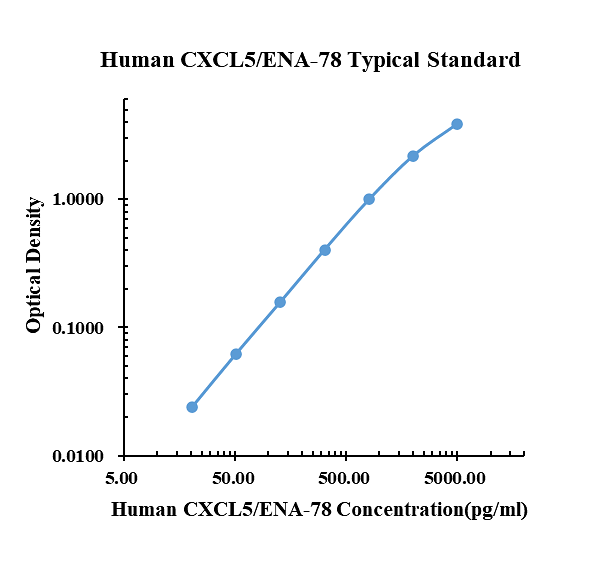
| pg/ml | O.D. | Average | Corrected | |
|---|---|---|---|---|
| 0.00 | 0.0134 | 0.0136 | 0.0135 | |
| 20.48 | 0.0370 | 0.0376 | 0.0373 | 0.0238 |
| 51.20 | 0.0745 | 0.0774 | 0.0760 | 0.0625 |
| 128.00 | 0.1724 | 0.1706 | 0.1715 | 0.1580 |
| 320.00 | 0.4228 | 0.4138 | 0.4183 | 0.4048 |
| 800.00 | 1.0020 | 1.0140 | 1.0080 | 0.9945 |
| 2000.00 | 2.2430 | 2.1530 | 2.1980 | 2.1845 |
| 5000.00 | 3.9350 | 3.8410 | 3.8880 | 3.8745 |
精度
| Intra-assay Precision | Inter-assay Precision | |||||
| Sample Number | S1 | S2 | S3 | S1 | S2 | S3 |
| 22 | 22 | 22 | 6 | 6 | 6 | |
| Average(pg/ml) | 135.3 | 659.5 | 1976.8 | 111.1 | 538.6 | 1723.8 |
| Standard Deviation | 8.7 | 37.6 | 102.5 | 4.3 | 17.4 | 78.9 |
| Coefficient of Variation(%) | 6.4 | 5.7 | 5.2 | 3.9 | 3.2 | 4.6 |
板内精密度:3 个已知浓度的样本酶标板内重复测定 22 次,评估酶标板内的精密度。
板间精密度:3 个已知浓度的样本酶标板间重复检测 6 次,评估酶标板间的精密度。
加标回收
健康人血清加入 3 个不同浓度水平的人 CXCL5/ENA-78 ,未加人 CXCL5/ENA-78 的血清作为本底,计算回收率。回收率的范围从 80 % 至 106 %,平均回收率为 89%。
样本值
| Sample Matrix | Sample Evaluated | Range (ng/ml) | Detectable (%) | Mean of Detectable (ng/ml) |
|---|---|---|---|---|
| Serum | 30 | 1.93-7.91 | 100 | 3.83 |
应用本试剂盒,检测 30 个健康志愿者的血清样本,志愿者的用药史不详。n.d. = 测不到浓度值。样本的浓度值低于灵敏度被认为测不到浓度值。
产品数据表
背景: CXCL5/ENA-78
该基因编码的蛋白质是趋化因子(C-X-C基序)配体5(CXCL5),是一种属于CXC趋化因子家族的小型细胞因子,也被称为上皮细胞来源的中性粒细胞激活肽78(ENA-78)。该趋化因子与白介素-8(IL8)同时产生,响应白介素-1(IL1)或肿瘤坏死因子α(TNFA)的刺激。观察到,CXCL5也表达于嗜酸性粒细胞中,并能与II型干扰素IFN-α相互作用,从而引起抑制作用。这种趋化因子刺激中性粒细胞的趋化性,具有血管生成特性,并通过与细胞表面趋化因子受体CXCR2相互作用来引发这些效应。