Mouse TSLP enzyme-linked immunoassay kit
| Specification | 96 Test |
|---|---|
| Sensitivity | 3.44 pg/ml (10 μl) |
| Standard Curve Range | 46.88~3000 pg/ml |
| Standard Curve Gradient | 7 Points |
| Number of Incubations | 2 |
| Detectable sample | Liquid phase sample of soluble substances. For example: serum, plasma, cell culture supernatant, tissue grinding liquid, etc. |
| Sample Volume | 10 μl |
| Type | Fully Ready-to-Use |
| Operation Duration | 120min |
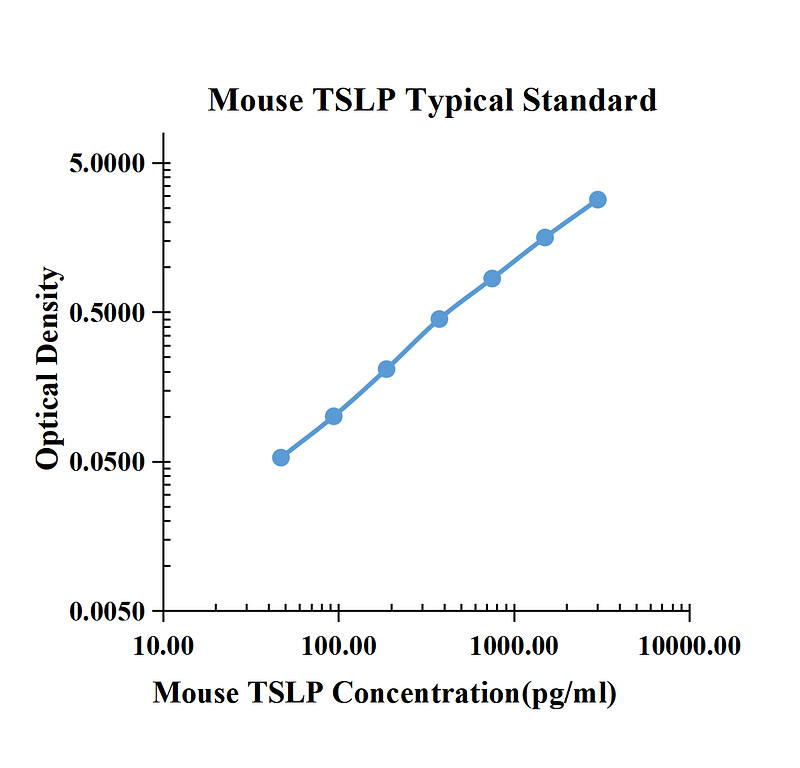
| pg/ml | O.D. | Average | Corrected | |
|---|---|---|---|---|
| 0.00 | 0.0260 | 0.0211 | 0.0236 | |
| 46.88 | 0.0730 | 0.0807 | 0.0769 | 0.0533 |
| 93.75 | 0.1270 | 0.1218 | 0.1244 | 0.1009 |
| 187.50 | 0.2381 | 0.2263 | 0.2322 | 0.2087 |
| 375.00 | 0.4863 | 0.4643 | 0.4753 | 0.4518 |
| 750.00 | 0.8973 | 0.8371 | 0.8672 | 0.8437 |
| 1500.00 | 1.6190 | 1.6040 | 1.6115 | 1.5880 |
| 3000.00 | 2.8250 | 2.9140 | 2.8695 | 2.8460 |
Precision
| Intra-assay Precision | Inter-assay Precision | |||||
| Sample Number | S1 | S2 | S3 | S1 | S2 | S3 |
| 22 | 22 | 22 | 6 | 6 | 6 | |
| Average(pg/ml) | 76.6 | 357.2 | 987.1 | 71.5 | 365.3 | 1014.8 |
| Standard Deviation | 3.2 | 14.8 | 53.5 | 4.9 | 14.6 | 36.3 |
| Coefficient of Variation(%) | 6.5 | 6.3 | 6.9 | 6.9 | 4.0 | 3.6 |
Intra-assay Precision (Precision within an assay) Three samples of known concentration were tested twenty-two times on one plate to assess intra-assay precision. Inter-assay Precision (Precision between assays) Three samples of known concentration were tested six times on one plate to assess intra-assay precision.
Spike Recovery
The spike recovery was evaluated by spiking 3 levels of mouse TSLP into health mouse serum sample. The un-spiked serum was used as blank in this experiment.
The recovery ranged from 81% to 117% with an overall mean recovery of 102%.
Sample Values
| Sample Matrix | Sample Evaluated | Range (pg/ml) | Detectable (%) | Mean of Detectable (pg/ml) |
|---|---|---|---|---|
| Serum | 30 | n.d.-13.08 | 6.25 | 13.08 |
Serum/Plasma – Thirty samples from apparently healthy mice were evaluated for the presence of TSLP in this assay. No medical histories were available for the donors.
n.d. = non-detectable. Samples measured below the sensitivity are considered to be non-detectable.
Product Data Sheet
Background: TSLP
Thymic Stromal Lymphopoietin (TSLP) was originally identified as an activity from the conditioned medium of a mouse thymic stromal cell line that promoted the development of B cells. The activities of mouse TSLP overlap with, but are distinct from, those of mouse IL-7. Both mouse TSLP and IL-7 can co-stimulate growth of thymocytes and mature T cells, and support B lymphopoiesis in long-term cultures of fetal liver cells and bone-marrow cells. Whereas mouse IL-7 facilitates the development of B220+/IgM- pre-B cells, mouse TSLP promotes the development B220+/IgM+ B cells. Human TSLP was reported to preferentially stimulate myeloid cells, inducing the release of T cell-attracting chemokines from monocytes and enhancing the maturation of CD11c+ dendritic cells. Human TSLP cDNA encodes a 159 amino acid (aa) residue precursor protein with a 28 aa signal sequence. Within the mature region, six of the seven cysteine residues present in the mouse TSLP involved in intramolecular disulfide bond formation are conserved in the human TSLP. Human TSLP shares approximately 43% aa sequence identity with mouse TSLP. By Northern blot analysis, human TSLP expression has been detected in many tissues with the highest expressions in heart, liver, testis and prostate. TSLP signals through a heterodimeric receptor complex that consists of IL-7 R alpha and the TSLP R, a member of the hemopoietin receptor family most closely related to Rgammac.
TSLP R, also named Delta and CRLM-2 (Cytokine Receptor-like Module-2), was originally cloned as a novel type 1 cytokine receptor with similarity to the common gamma chain (gamma c). It was subsequently identified as a subunit of the cellular receptor for the IL-7-like cytokine TSLP and termed TSLP R. TSLP R shows 24% sequence identity with the mouse gc receptor. TSLP R expression is constitutive in immune and hematopoietic cells, but is up-regulated in Th2 cells.