Mouse/Rat P-Cadherin/Cadherin-3/CDH3 enzyme-linked immunoassay kit(one step)
| Specification | 96 Test |
|---|---|
| Sensitivity | 0.09ng/ml (10 μl) |
| Standard Curve Range | 0.69 ~500 ng/ml |
| Standard Curve Gradient | 7 Points/3 Folds |
| Number of Incubations | 1 |
| Detectable sample | serum, plasma |
| Sample Volume | 10 μl |
| Type | Ready-to-Use |
| Operation Duration | 60min |
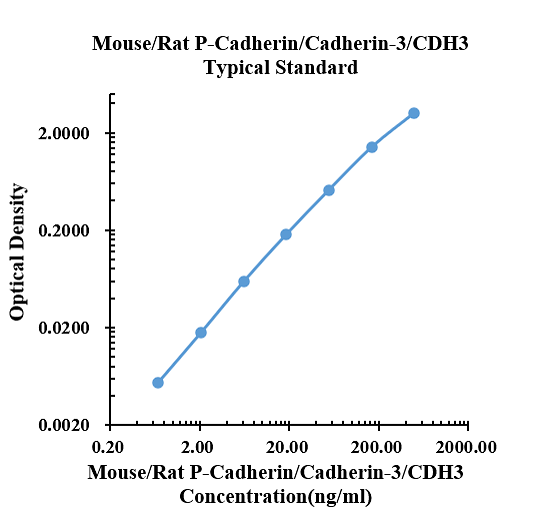
| ng/ml | O.D. | Average | Corrected | |
|---|---|---|---|---|
| 0.00 | 0.0066 | 0.0066 | 0.0066 | |
| 0.69 | 0.0116 | 0.0125 | 0.0121 | 0.0055 |
| 2.06 | 0.0239 | 0.0247 | 0.0243 | 0.0177 |
| 6.17 | 0.0655 | 0.0662 | 0.0659 | 0.0593 |
| 18.52 | 0.1882 | 0.1868 | 0.1875 | 0.1809 |
| 55.56 | 0.5271 | 0.5229 | 0.5250 | 0.5184 |
| 166.67 | 1.4330 | 1.4280 | 1.4305 | 1.4239 |
| 500.00 | 3.2280 | 3.1870 | 3.2075 | 3.2009 |
Precision
| Intra-assay Precision | Inter-assay Precision | |||||
| Sample Number | S1 | S2 | S3 | S1 | S2 | S3 |
| 22 | 22 | 22 | 6 | 6 | 6 | |
| Average(ng/ml) | 7.4 | 39.2 | 130.1 | 8.1 | 41.9 | 128.7 |
| Standard Deviation | 0.4 | 2.5 | 7.5 | 0.5 | 2.2 | 6.1 |
| Coefficient of Variation(%) | 5.7 | 6.3 | 5.7 | 6.8 | 5.2 | 4.8 |
Intra-assay Precision (Precision within an assay) Three samples of known concentration were tested twenty-two times on one plate to assess intra-assay precision. Inter-assay Precision (Precision between assays) Three samples of known concentration were tested six times on one plate to assess intra-assay precision.
Spike Recovery
The spike recovery was evaluated by spiking 3 levels of mouse/rat P-Cadherin/Cadherin-3/CDH3 into health mouse/rat serum sample. The un-spiked serum was used as blank in this experiment.
The recovery ranged from 95% to 119% with an overall mean recovery of 112%.
Sample Values
| Sample Matrix | Sample Evaluated | Range (ng/ml) | Detectable (%) | Mean of Detectable (ng/ml) |
|---|---|---|---|---|
| Mouse Serum | 30 | 2.02-16.27 | 100 | 10.59 |
| Rat Serum | 30 | 3.60-58.20 | 100 | 28.97 |
Serum/Plasma – Thirty samples from apparently healthy mice and thirty samples from apparently healthy rats were evaluated for the presence of mouse/rat P-Cadherin/Cadherin-3/CDH3 in this assay. No medical histories were available for the donors.n.d. = non-detectable. Samples measured below the sensitivity are considered to be non-detectable.
Product Data Sheet
Background: P-Cadherin/Cadherin-3/CDH3
Placental Cadherin (P-Cadherin or PCAD) is a member of the cadherin family of cell adhesion molecules. Cadherins are calcium-dependent transmembrane proteins, which bind to one another in a homophilic manner. On their cytoplasmic side, they associate with the three catenins, alpha, beta, and gamma (plakoglobin). This association links the cadherin protein to the cytoskeleton. Without association with the catenins, the cadherins are non-adhesive. Cadherins play a role in development, specifically in tissue formation. They may also help to maintain tissue architecture in the adult. P-Cadherin is a classical cadherin molecule. Classical cadherins consist of a large extracellular domain which contains DXD and DXNDN repeats responsible for mediating calcium-dependent adhesion, a single-pass transmembrane domain, and a short carboxy-terminal cytoplasmic domain responsible for interacting with the catenins. Constitutive P-Cadherin expression is found in the epidermis, mesothelium, corneal epithelium, and uterine decidua. Mouse P-Cadherin is an 822 amino acid (aa) protein with a 27 aa signal sequence and a 795 aa propeptide. The mature protein begins at aa 100 and has a 542 aa extracellular region, a 27 aa transmembrane region, and a 153 aa cytoplasmic region.