Mouse/Rat IGF1 DTSet enzyme-linked immunoassay kit
| Specification | 96*5 Test;96T*15 Test |
|---|---|
| Standard Curve Range | 62.50 pg/ml-4000 pg/ml |
| Standard Curve Gradient | 7 Points/3 Folds |
| Number of Incubations | 2 |
| Sample Volume | 50 μl |
| Type | Not Ready-to-Use |
| Test Duration | 120min |
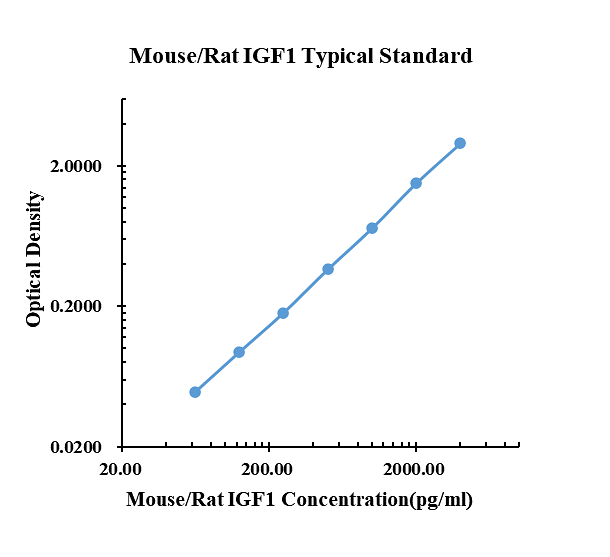
| pg/ml | O.D. | Average | Corrected | |
|---|---|---|---|---|
| 0.00 | 0.0413 | 0.0391 | 0.0402 | |
| 62.50 | 0.0906 | 0.0876 | 0.0891 | 0.0489 |
| 125.00 | 0.1293 | 0.1396 | 0.1345 | 0.0943 |
| 250.00 | 0.2240 | 0.2156 | 0.2198 | 0.1796 |
| 500.00 | 0.4115 | 0.4003 | 0.4059 | 0.3657 |
| 1000.00 | 0.7669 | 0.7470 | 0.7570 | 0.7168 |
| 2000.00 | 1.5970 | 1.4890 | 1.5430 | 1.5028 |
| 4000.00 | 3.0150 | 2.8350 | 2.9250 | 2.8848 |
Product Features
- Optimized capture and detection antibody pairings with recommended concentrations save lengthy development time
- Development protocols are provided to guide further assay optimization
- Assay can be customized to your specific needs
- Economical alternative to complete kits
Kit Content
- Capture Antibody
- Detection Antibody
- Recombinant Standard
- Streptavidin conjugated to horseradish-peroxidase (Streptavidin-HRP)
Other Reagents Required
DTSet Ancillary Reagent Kit (5 plates): containing 96 well microplates, plate sealers, substrate solution, stop solution, plate coating buffer (PBS), wash buffer, and assay buffer.
- 96 well microplates: YOUKE Life, Catalog # DSEP01. Plate Sealers: YOUKE Life, Catalog # DSSF01.
- Coating Buffer: 137 mM NaCl, 2.7 mM KCl, 8.1 mM Na2HPO4, 1.5 mM KH2PO4, pH 7.2-7.4, 0.2μm filtered . YOUKE Life, Catalog # DSCB01.
- Blocking Buffer: YOUKE Life, Catalog # DSBB01.
- Wash Buffer: 0.05% Tween® 20 in PBS, pH 7.2-7.4. YOUKE Life, Catalog # DSWB01.
- Assay Buffer: 0.5% BSA,0.05% Tween® 20,PBS Solution.YOUKE Life, Catalog # DSAB01
- Substrate Solution: Tetramethylbenzidine. YOUKE Life, Catalog # DSTS01.
- Stop Solution: 0.5mol/ml H2SO4. YOUKE Life, Catalog # DSSS01.
Product Data Sheet
Background: IGF1
IGF-I receptor is a disulfide-linked heterotetrameric transmembrane protein consisting of two alpha and two beta subunits. Both the alpha and beta subunits are encoded within a single receptor precursor cDNA. The proreceptor polypeptide is proteolytically cleaved and disulfide-linked to yield the mature heterotetrameric receptor. The alpha subunit of IGF-I receptor is extracellular while the beta subunit has an extracellular domain, a transmembrane domain and a cytoplasmic tyrosine kinase domain. The IGF-I receptor is highly expressed in all cell types and tissues.
IGF-II R is a type I transmembrane glycoprotein that contains a 2,264 amino acid (aa) extracellular region, a 23 aa transmembrane segment segment and a 124 aa cytoplasmic tail. IGF-II R regulates many diverse biological functions that range from intracellular trafficking to the internalization of extracellular factors and modulation of cellular responses. It delivers newly synthesized M6P-tagged lysosomal enzymes from the trans-golgi network to endosomes, and facilitates the clearance of extracellular lysosomal and matrix degrading enzymes by internalization into clathrin-coated vesicles and delivery into endosomes. With respect to IGF-II biology, It would appear that IGF-II R is principally a regulator of local IGF-II levels, targeting IGF-II for destruction in lysosomes.
The heterotetrameric receptors for insulin (INS R) and IGF-I (IGF-I R) are receptor tyrosine kinases that consist of two ligandbinding alpha subunits and two beta subunits. Ligand binding induces autophosphorylation on multiple tyrosine residues of beta subunits. Phosphorylation of Tyr1162 and 1163 on INS R and Tyr1135 and 1136 on IGF-I R stimulates intrinsic kinase activity.