Mouse/Rat Galectin-1/LGALS 1 enzyme-linked immunoassay kit
| Specification | 96 Test |
|---|---|
| Sensitivity | 10.44pg/ml (10 μl) |
| Standard Curve Range | 40.96 ~10000 pg/ml |
| Standard Curve Gradient | 7 Points |
| Number of Incubations | 2 |
| Detectable sample | Liquid phase sample of soluble substances. For example: serum, plasma, cell culture supernatant, tissue grinding liquid, etc. |
| Sample Volume | 10 μl |
| Type | Ready-to-Use |
| Operation Duration | 120min |
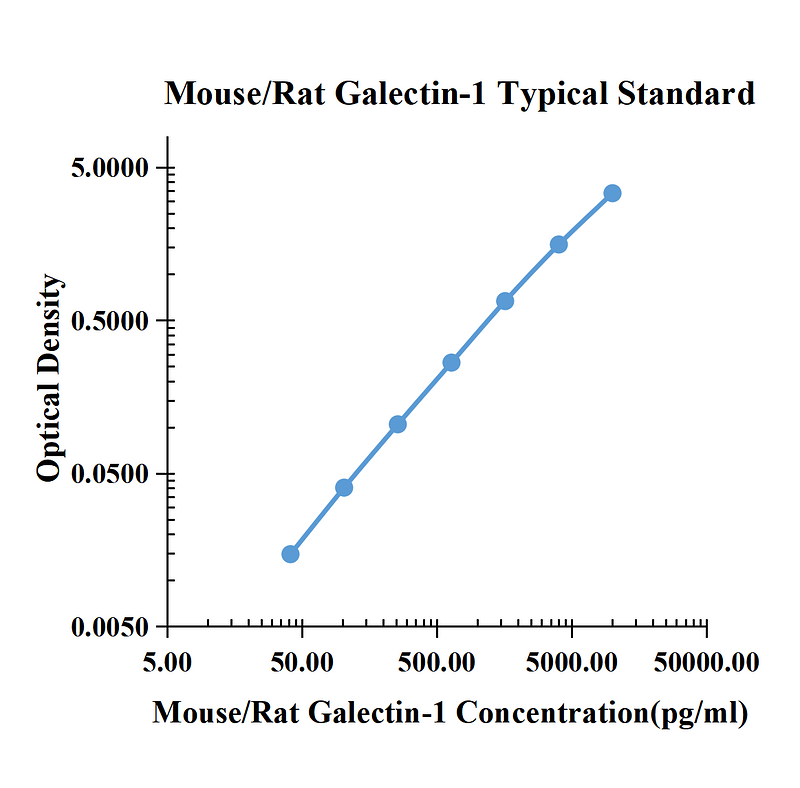
| pg/ml | O.D. | Average | Corrected | |
|---|---|---|---|---|
| 0.00 | 0.0389 | 0.0358 | 0.0374 | |
| 40.96 | 0.0528 | 0.0517 | 0.0523 | 0.0149 |
| 102.40 | 0.0805 | 0.0753 | 0.0779 | 0.0406 |
| 256.00 | 0.1469 | 0.1381 | 0.1425 | 0.1052 |
| 640.00 | 0.3043 | 0.3025 | 0.3034 | 0.2661 |
| 1600.00 | 0.6994 | 0.7174 | 0.7084 | 0.6711 |
| 4000.00 | 1.6320 | 1.5880 | 1.6100 | 1.5727 |
| 10000.00 | 3.4380 | 3.4400 | 3.4390 | 3.4017 |
Precision
| Intra-assay Precision | Inter-assay Precision | |||||
| Sample Number | S1 | S2 | S3 | S1 | S2 | S3 |
| 22 | 22 | 22 | 6 | 6 | 6 | |
| Average(pg/ml) | 212.8 | 1018.4 | 3111.5 | 225.4 | 1101.1 | 3275.6 |
| Standard Deviation | 10.1 | 50.9 | 226.1 | 16.3 | 39.7 | 60.1 |
| Coefficient of Variation(%) | 4.8 | 5.0 | 7.3 | 7.2 | 3.6 | 1.8 |
Intra-assay Precision (Precision within an assay) Three samples of known concentration were tested twenty-two times on one plate to assess intra-assay precision. Inter-assay Precision (Precision between assays) Three samples of known concentration were tested six times on one plate to assess intra-assay precision.
Spike Recovery
The spike recovery was evaluated by spiking 3 levels of mouse/rat Galectin-1/LGALS1 into health mouse/rat serum sample. The un-spiked serum was used as blank in this experiment.
The recovery ranged from 80% to 120% with an overall mean recovery of 107%.
Sample Values
| Sample Matrix | Sample Evaluated | Range (ng/ml) | Detectable (%) | Mean of Detectable (ng/ml) |
|---|---|---|---|---|
| Mouse Serum | 30 | 8.79-28.10 | 100 | 19.50 |
| Rat Serum | 30 | 11.93-73.91 | 100 | 28.40 |
Serum/Plasma – Thirty samples from apparently healthy mice and thirty samples from apparently healthy rats were evaluated for the presence of Galectin-1/LGALS1 in this assay. No medical histories were available for the donors. n.d. = non-detectable. Samples measured below the sensitivity are considered to be non-detectable.
Product Data Sheet
Background: Galectin-1/LGALS 1
The galectins constitute a large family of carbohydrate-binding proteins with specificity for N-acetyl-lactosamine-containing glycoproteins. At least 14 mammalian galectins, which share structural similarities in their carbohydrate recognition domains (CRD), have been identified to date. The galectins have been classified into the prototype galectins (-1, -2, -5, -7, -10, -11, -13, -14), which contain one CRD and exist either as a monomer or a noncovalent homodimer; the chimera galectins (Galectin-3) containing one CRD linked to a nonlectin domain; and the tandem-repeat galectins (-4, -6, -8, -9, -12) consisting of two CRDs joined by a linker peptide. Galectins lack a classical signal peptide and can be localized to the cytosolic compartments where they have intracellular functions. However, via one or more as yet unidentified non-classical secretory pathways, galectins can also be secreted to function extracellularly. Individual members of the galectin family have different tissue distribution profiles and exhibit subtle differences in their carbohydrate-binding specificities. Each family member may preferentially bind to a unique subset of cell-surface glycoproteins.
Mouse Galectin-1, also known as beta-galactoside-binding lectin L-14-I, lactose-binding lectin 1, S-Lac lectin 1, galaptin and 14 kDa lectin, is a monomeric or homodimeric prototype galectin that is expressed in a variety of cells and tissues including muscle, heart, lymph nodes, spleen, thymus, macrophages, B cells, T cells, dendritic cells, and tumor cells. It preferentially binds laminin, fibronectin, 90K/Mac-2BP, CD45, CD43, CD7, CD2, CD3, and ganglioside GM1. Galectin-1 modulates cell growth, proliferation and differentiation, either positively or negatively, depending on the cell type and activation status. It controls cell survival by inducing apoptosis of activated T cells and immature thymocytes. It modulates cytokine secretion by inducing Th2 type cytokines and inhibiting pro-inflammatory cytokine production. Galectin-1 can also modulate cell-cell as well as cell-matrix interactions and depending on the cell type and developmental stage, promote cell attachment or detachment. Galectin-1 has immunosuppressive and anti-inflammatory properties and has been shown to suppress acute and chronic inflammation and autoimmunity. Mouse and human Galectin-1 share about 88% amino acid sequence similarity.