Mouse/Rat CD38 enzyme-linked immunoassay kit
| Specification | 96 Test |
|---|---|
| Sensitivity | 2.46 pg/ml (10 μl) |
| Standard Curve Range | 12.29 ~3000 pg/ml |
| Standard Curve Gradient | 7 Points |
| Number of Incubations | 2 |
| Detectable sample | Liquid phase sample of soluble substances. For example: serum, plasma, cell culture supernatant, tissue grinding liquid, etc. |
| Sample Volume | 10 μl |
| Type | Fully Ready-to-Use |
| Operation Duration | 120min |
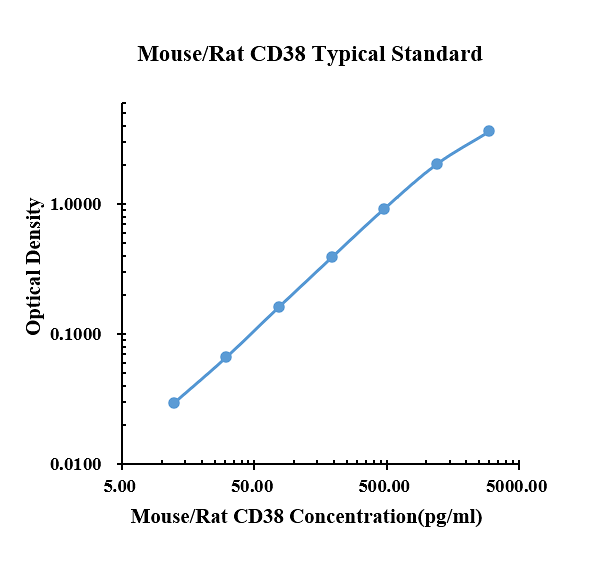
| pg/ml | O.D. | Average | Corrected | |
|---|---|---|---|---|
| 0.00 | 0.0559 | 0.0568 | 0.0564 | |
| 12.29 | 0.0864 | 0.0851 | 0.0858 | 0.0294 |
| 30.72 | 0.1195 | 0.1260 | 0.1228 | 0.0664 |
| 76.80 | 0.2224 | 0.2139 | 0.2182 | 0.1618 |
| 192.00 | 0.4462 | 0.4426 | 0.4444 | 0.3881 |
| 480.00 | 0.9767 | 0.9764 | 0.9766 | 0.9202 |
| 1200.00 | 2.0930 | 2.0860 | 2.0895 | 2.0332 |
| 3000.00 | 3.7640 | 3.5980 | 3.6810 | 3.6247 |
Precision
| Intra-assay Precision | Inter-assay Precision | |||||
| Sample Number | S1 | S2 | S3 | S1 | S2 | S3 |
| 22 | 22 | 22 | 6 | 6 | 6 | |
| Average(pg/ml) | 54.4 | 279.9 | 864.0 | 57.2 | 300.5 | 884.0 |
| Standard Deviation | 2.2 | 14.4 | 45.3 | 2.4 | 16.3 | 24.5 |
| Coefficient of Variation(%) | 4.0 | 5.2 | 5.2 | 4.3 | 5.4 | 2.8 |
Intra-assay Precision (Precision within an assay) Three samples of known concentration were tested twenty-two times on one plate to assess intra-assay precision. Inter-assay Precision (Precision between assays) Three samples of known concentration were tested six times on one plate to assess intra-assay precision.
Spike Recovery
The spike recovery was evaluated by spiking 3 levels of mouse/rat CD38 into health mouse/rat serum sample. The un-spiked serum was used as blank in this experiment.
The recovery ranged from 80% to 120% with an overall mean recovery of 97%.
Sample Values
| Sample Matrix | Sample Evaluated | Range (pg/ml) | Detectable (%) | Mean of Detectable (pg/ml) |
|---|---|---|---|---|
| Mouse Serum | 30 | 115.90-360.35 | 100 | 297.25 |
| Rat Serum | 30 | 8.68-53.49 | 100 | 21.16 |
Serum/Plasma – Thirty samples from apparently healthy mice and thirty samples from apparently healthy rats were evaluated for the presence of CD38 in this assay. No medical histories were available for the donors. n.d. = non-detectable. Samples measured below the sensitivity are considered to be non-detectable.
Product Data Sheet
Background: CD38
CD38 (cluster of differentiation 38), previously known as T10, is a 46 kDa type II transmembrane glycoprotein . CD38 is expressed in both lymphoid and non-lymphoid tissue including in thymocytes, T and B lymphocytes, myeloid cells, natural killer cells, plasma cells, erythrocytes, and additionally in cells of the brain, pancreas, muscle, and bone. Structurally, CD38 is an "L"-shape which is formed by two separate domains connected by a three peptide-chain hinge region. The N-terminal domain is composed of five alpha-helices and two beta strands, while the C-terminal domain contains a four-stranded parallel beta-sheet and two long and two short alpha-helices . The CD38 molecule is located on chromosome 4 and is 300 amino acids (aa) in length with a theoretical molecular weight of 34 kDa that functions as both a receptor and an enzyme. As a receptor, CD38 interacts with its ligand CD31, which is largely expressed in endothelial cells. As an ectoenzyme, CD38 has a role in calcium signaling and is responsible for the conversion of nicotinamide adenine dinucleotide (NAD) into adenosine diphosphate-ribose (ADPR) or cyclic ADPR and the conversion of phosphorylated NAD (NADP) into nicotinic acid adenine dinucleotide phosphate (NAADP).
As described above, CD38 is highly expressed in plasma cells and, as a result, is a target for treating multiple myeloma (MM), the cancer of white blood cells. The anti-CD38 monoclonal antibody daratumumab is one specific treatment for MM. Daratumumab has been shown to target MM cells through antibody-dependent cellular cytotoxicity and antibody dependent cellular phagocytosis. Additionally, CD38 has a potential role in neurodegenerative disorders and neuroinflammation as elucidated CD38's high expression in neurons, astrocytes, and microglia along with its enzymatic role in NAD degradation. Reduced NAD levels is a consequence of aging and occurs during neurodegeneration. Furthermore, murine studies have found that CD38 deletion inhibits neuroinflammation and neurodegeneration and therefore might be a potential therapeutic target. Similarly, CD38 inhibitors, like quercetin and luteolin, are used to treat age-related diseases and metabolic disorders.