Mouse CD86 DTSet enzyme-linked immunoassay kit
| Specification | 96*5 Test;96T*15 Test |
|---|---|
| Standard Curve Range | 78.13pg/ml-5000pg/ml |
| Standard Curve Gradient | 7 Points/3 Folds |
| Number of Incubations | 2 |
| Sample Volume | 10 μl |
| Type | Not Ready-to-Use |
| Test Duration | 120min |
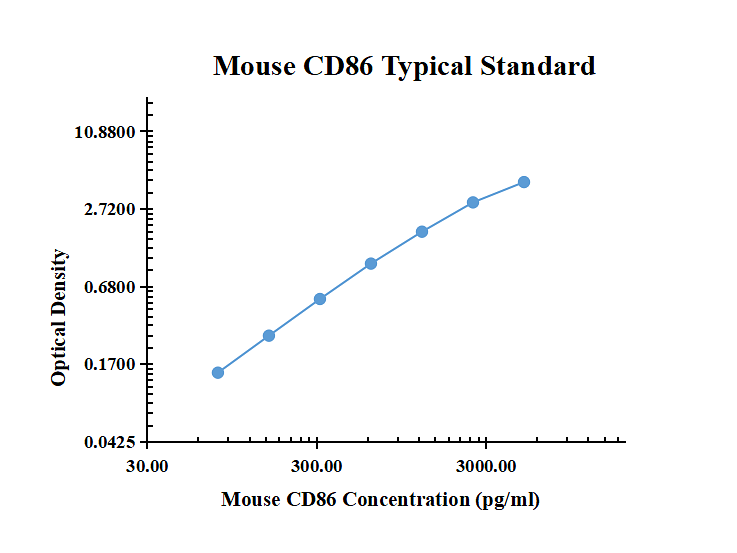
| pg/ml | O.D. | Average | Corrected | |
|---|---|---|---|---|
| 0.00 | 0.0120 | 0.0098 | 0.0109 | |
| 78.13 | 0.1605 | 0.1531 | 0.1568 | 0.1459 |
| 156.25 | 0.3106 | 0.2766 | 0.2936 | 0.2827 |
| 312.50 | 0.5768 | 0.5337 | 0.5553 | 0.5444 |
| 625.00 | 1.0650 | 1.0060 | 1.0355 | 1.0246 |
| 1250.00 | 1.8200 | 1.8250 | 1.8225 | 1.8116 |
| 2500.00 | 3.0190 | 3.1200 | 3.0695 | 3.0586 |
| 5000.00 | 4.2870 | 4.5288 | 4.4079 | 4.3970 |
Product Features
- Optimized capture and detection antibody pairings with recommended concentrations save lengthy development time
- Development protocols are provided to guide further assay optimization
- Assay can be customized to your specific needs
- Economical alternative to complete kits
Kit Content
- Capture Antibody
- Detection Antibody
- Recombinant Standard
- Streptavidin conjugated to horseradish-peroxidase (Streptavidin-HRP)
Other Reagents Required
DTSet Ancillary Reagent Kit (5 plates): containing 96 well microplates, plate sealers, substrate solution, stop solution, plate coating buffer (PBS), wash buffer, and assay buffer.
- 96 well microplates: YOUKE Life, Catalog # DSEP01. Plate Sealers: YOUKE Life, Catalog # DSSF01.
- Coating Buffer: 137 mM NaCl, 2.7 mM KCl, 8.1 mM Na2HPO4, 1.5 mM KH2PO4, pH 7.2-7.4, 0.2μm filtered . YOUKE Life, Catalog # DSCB01.
- Blocking Buffer: YOUKE Life, Catalog # DSBB01.
- Wash Buffer: 0.05% Tween® 20 in PBS, pH 7.2-7.4. YOUKE Life, Catalog # DSWB01.
- Assay Buffer: 0.5% BSA,0.05% Tween® 20,PBS Solution.YOUKE Life, Catalog # DSAB01
- Substrate Solution: Tetramethylbenzidine. YOUKE Life, Catalog # DSTS01.
- Stop Solution: 0.5mol/ml H2SO4. YOUKE Life, Catalog # DSSS01.
Product Data Sheet
Background: CD86
B7-2, also known as CD86, B70, and ETC-1, is a 60-100 kDa variably glycosylated protein in the B7 family. B7 family members are transmembrane cell surface molecules that play important roles in immune activation and the maintenance of immune tolerance. Mature human B7-2 consists of a 224 amino acid (aa) extracellular domain (ECD) with two Ig-like domains, a 21 aa transmembrane segment, and a 61 aa cytoplasmic tail (3, 4). Within the ECD, human B7-2 shares 59% aa sequence identity with mouse and rat B7-2. Alternative splicing of human B7-2 generates additional isoforms that lack both Ig-like domains or a region that includes the transmembrane segment. B7-2 is highly expressed on activated antigen presenting cells (APC), e.g. B cells, dendritic cells, and monocytes, as well as on vascular endothelial cells. B7-2 and the closely related B7-1/CD80 exhibit overlapping but distinct functional properties. Their binding to CD28, which is constitutively expressed on T cells, enhances T cell receptor signaling and also provides TCR-independent co-stimulation. B7-1 and B7-2 additionally bind the CD28-related protein, CTLA-4, which is up‑regulated and recruited to the immunological synapse (IS) at the onset of T cell activation. CTLA-4 ligation inhibits the T cell response and supports regulatory T cell function. B7-2 is expressed earlier than B7-1 following APC activation, and both proteins bind with higher affinity to CTLA-4 than to CD28. B7-2 promotes the stabilization of CD28 in the IS, while B7-1 is primarily responsible for promoting CTLA-4 recruitment and accumulation in the IS. The relative participation of B7-1 and B7-2 in T cell co-stimulation can also alter the Th1/Th2 bias of the immune response. Both B7-1 and B7-2 serve as cellular receptors for B species adenoviruses.