Human WNT7A enzyme-linked immunoassay kit
| Specification | 96 Test |
|---|---|
| Sensitivity | 3.62 pg/ml (50 μl);7.94 pg/ml (10 μl); |
| Standard Curve Range | 40.96 ~10000 pg/ml |
| Standard Curve Gradient | 7 Points |
| Number of Incubations | 2 |
| Detectable sample | Liquid phase sample of soluble substances. For example: serum, plasma, cell culture supernatant, tissue grinding liquid, etc. |
| Sample Volume | 50 μl/10 μl |
| Type | Fully Ready-to-Use |
| Operation Duration | 120min |
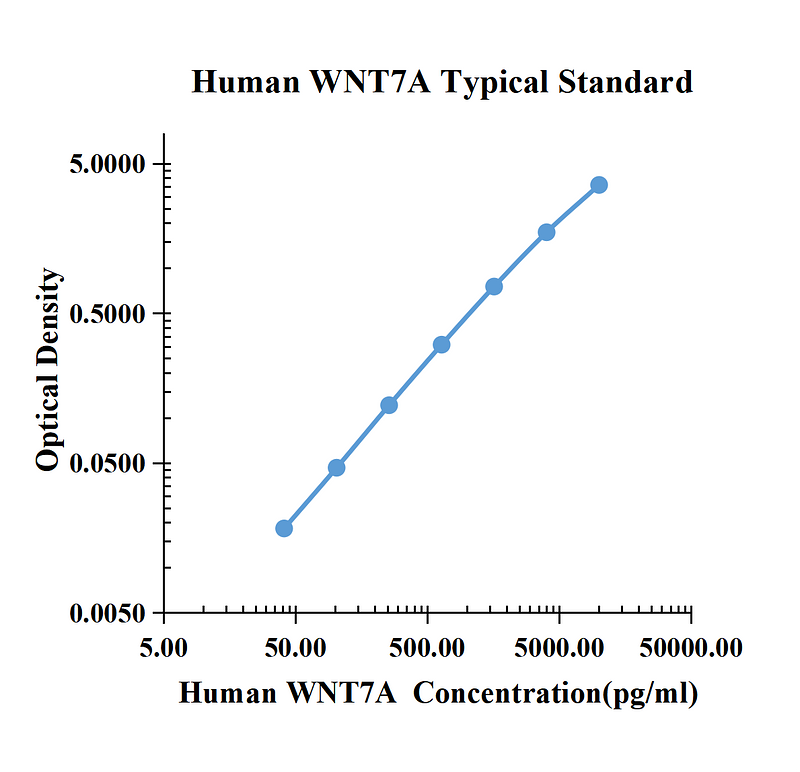
| pg/ml | O.D. | Average | Corrected | |
|---|---|---|---|---|
| 0.00 | 0.0164 | 0.0152 | 0.0158 | |
| 40.96 | 0.0351 | 0.0332 | 0.0342 | 0.0184 |
| 102.40 | 0.0619 | 0.0631 | 0.0625 | 0.0467 |
| 256.00 | 0.1375 | 0.1384 | 0.1380 | 0.1222 |
| 640.00 | 0.3264 | 0.3251 | 0.3258 | 0.3100 |
| 1600.00 | 0.7644 | 0.7827 | 0.7736 | 0.7578 |
| 4000.00 | 1.7650 | 1.7600 | 1.7625 | 1.7467 |
| 10000.00 | 3.6480 | 3.6180 | 3.6330 | 3.6172 |
Precision
| Intra-assay Precision | Inter-assay Precision | |||||
| Sample Number | S1 | S2 | S3 | S1 | S2 | S3 |
| 22 | 22 | 22 | 6 | 6 | 6 | |
| Average(pg/ml) | 138.8 | 772.3 | 2512.3 | 226.3 | 1112.0 | 3465.9 |
| Standard Deviation | 10.5 | 40.6 | 169.6 | 14.9 | 20.6 | 123.0 |
| Coefficient of Variation(%) | 7.6 | 5.3 | 6.8 | 6.6 | 1.9 | 3.5 |
Intra-assay Precision (Precision within an assay) Three samples of known concentration were tested twenty-two times on one plate to assess intra-assay precision. Inter-assay Precision (Precision between assays) Three samples of known concentration were tested six times on one plate to assess intra-assay precision.
Spike Recovery
The spike recovery was evaluated by spiking 3 levels of human WNT7A into health human serum sample. The un-spiked serum was used as blank in this experiment.
The recovery ranged from 81% to 109% with an overall mean recovery of 94%.
Sample Values
| Sample Matrix | Sample Evaluated | Range (pg/ml) | Detectable (%) | Mean of Detectable (pg/ml) |
|---|---|---|---|---|
| Serum | 30 | n.d.-1.92 | 31.25 | 1.26 |
Serum/Plasma – Thirty samples from apparently healthy volunteers were evaluated for the presence of human WNT7A in this assay. No medical histories were available for the donors. n.d. = non-detectable. Samples measured below the sensitivity are considered to be non-detectable.
Product Data Sheet
Background: WNT7A
Human Wnt-7a is one of about 19 vertebrate members of the Wingless-type MMTV integration site (Wnt) family of highly conserved cysteine-rich secreted glycoproteins important for normal developmental processes. Wnts bind to receptors of the Frizzled family in conjunction with low-density lipoprotein receptor‑related proteins (LRPs). Downstream effects of Wnt signaling occur through activation of one of three different intracellular pathways: the canonical Wnt pathway, Wnt/Ca2+ pathway, and planar cell polarity. The highly transforming Wnts, including Wnt-1, -3, -3a, -7a and -8 activate the canonical pathway, which regulates beta ‑catenin-mediated gene expression. Human Wnt‑7a is a 48 kDa secreted glycoprotein containing 24 cysteine residues that is expressed by epithelial and epithelially-derived cells of the placenta, kidney, testis, uterus, fetal lung, and fetal and adult brain. Palmitate modification of a cysteine residue has been shown for Wnt‑3a; this site is conserved on all Wnts and is Cys73 on Wnt‑7a. When modified, increased hydrophobicity and activity is expected. Human Wnt‑7a shows 97% aa identity with mouse, rat, and dog Wnt‑7a and 92% aa identity with chicken Wnt‑7a. During development, Wnt‑7a is expressed by the dorsal ectoderm and drives expression of homeodomain transcription factors that control effectors important in patterning and cell fates in adjacent mesenchyme. When Wnt‑7a is deleted, mice show disruption of dorsalization and anterior/posterior patterning during limb development and abnormalities in the reproductive tract. Wnt‑7a is frequently downregulated in leukemia and lung cancers, potentially affecting homeobox (HOX) gene expression, differentiation state and growth control. Roles for Wnt‑7a have also been shown during formation of neural synapses, response of the uterus to estrogen and inflammatory cartilage destruction. Wnt-7b is a 46 kDa, secreted glycosylated protein that belongs to the Wnt family. Wnt proteins can be lipid-modified and are ligands for members of the frizzled family of receptors, which mediates cell-cell communication during development. Human Wnt-7b is synthesized as a 349 amino acid (aa) precursor that contains a 318 aa mature region. The mature region contains 24 cysteines and three potential N-linked glycosylation sites. Wnt-7b is a ligand for members of the frizzled family of seven transmembrane receptors. Probable developmental protein. May be a signaling molecule which affects the development of discrete regions of tissues. Is likely to signal over only few cell diameters. Mature human Wnt-7b shares 99% aa sequence identity with mature mouse and rat Wnt-7b. Wnt-7b also shares 80% aa sequence identity with Wnt-7a.