Human Tau//MAPT enzyme-linked immunoassay kit
| Specification | 96 Test |
|---|---|
| Sensitivity | 3.47pg/ml (50 μl);6.37 pg/ml (10 μl); |
| Standard Curve Range | 20.48 ~5000 pg/ml |
| Standard Curve Gradient | 7 Points |
| Number of Incubations | 2 |
| Detectable sample | Liquid phase sample of soluble substances. For example: serum, plasma, cell culture supernatant, tissue grinding liquid, etc. |
| Sample Volume | 50 μl/10 μl |
| Type | Ready-to-Use |
| Operation Duration | 120min |
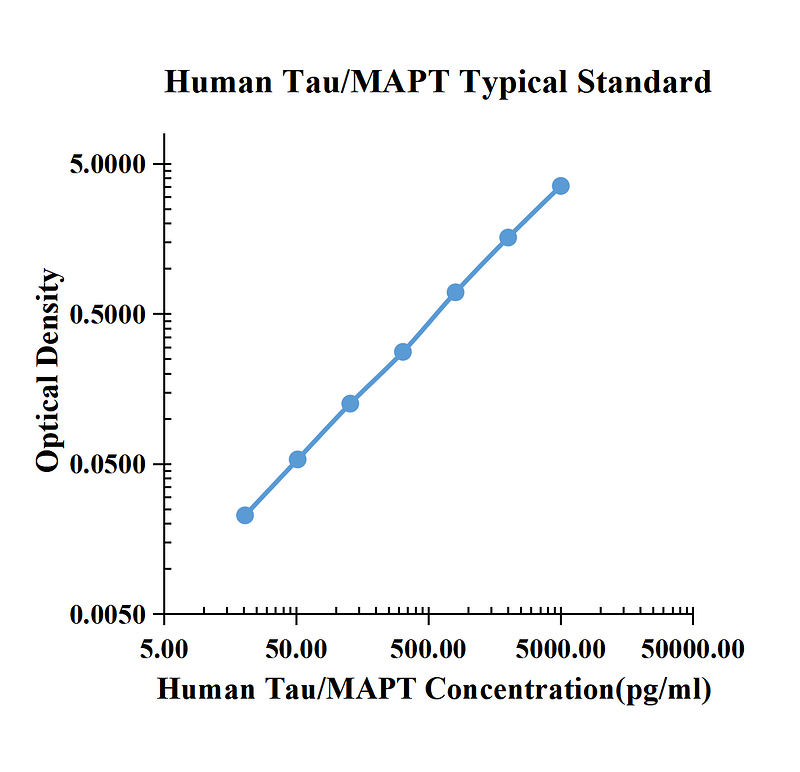
| pg/ml | O.D. | Average | Corrected | |
|---|---|---|---|---|
| 0.00 | 0.0292 | 0.0295 | 0.0294 | |
| 20.48 | 0.0506 | 0.0537 | 0.0522 | 0.0228 |
| 51.20 | 0.0794 | 0.0868 | 0.0831 | 0.0538 |
| 128.00 | 0.1494 | 0.1625 | 0.1560 | 0.1266 |
| 320.00 | 0.2918 | 0.3269 | 0.3094 | 0.2800 |
| 800.00 | 0.6706 | 0.7848 | 0.7277 | 0.6984 |
| 2000.00 | 1.5620 | 1.7330 | 1.6475 | 1.6182 |
| 5000.00 | 3.5600 | 3.6420 | 3.6010 | 3.5717 |
Precision
| Intra-assay Precision | Inter-assay Precision | |||||
| Sample Number | S1 | S2 | S3 | S1 | S2 | S3 |
| 22 | 22 | 22 | 6 | 6 | 6 | |
| Average(pg/ml) | 74.2 | 409.6 | 1309.9 | 92.4 | 497.6 | 1581.1 |
| Standard Deviation | 5.5 | 19.3 | 63.4 | 4.4 | 24.1 | 36.4 |
| Coefficient of Variation(%) | 7.5 | 4.7 | 4.8 | 4.7 | 4.8 | 2.3 |
Intra-assay Precision (Precision within an assay) Three samples of known concentration were tested twenty-two times on one plate to assess intra-assay precision. Inter-assay Precision (Precision between assays) Three samples of known concentration were tested six times on one plate to assess intra-assay precision.
Spike Recovery
The spike recovery was evaluated by spiking 3 levels of human Tau/MAPT into health human serum sample. The un-spiked serum was used as blank in this experiment.
The recovery ranged from 80% to 107% with an overall mean recovery of 98%.
Sample Values
| Sample Matrix | Sample Evaluated | Range (pg/ml) | Detectable (%) | Mean of Detectable (pg/ml) |
|---|---|---|---|---|
| Serum | 30 | n.d.-45.74 | 43.75 | 13.76 |
Serum/Plasma– Thirty samples from apparently healthy volunteers serum were evaluated for the presence of human Tau/MAPT in this assay. No medical histories were available for the donors. n.d. = non-detectable. Samples measured below the sensitivity are considered to be non-detectable.
Product Data Sheet
Background: Tau//MAPT
Tau is a relatively low molecular weight member of the microtubule associated protein or MAP family. Most of these proteins were discovered since microtubules can be polymerized in cell homogenates and pelleted out by centrifugation, typically taking MAP proteins with them. This early work showed that the Tau protein facilitated the polymerization of microtubules, and was therefore named after the Greek letter tau, since it promoted tubule formation. Tau is heavily concentrated in axons of neurons, but may also be found in dendrites and in some non-neuronal cells. Much interest has focused on Tau as it is a major component of the neurofibrillary tangles of Alzheimer's disease. Tau in neurofibrillary tangles is typically heavily and aberrantly phosphorylated, and it is believed that phosphorylation may be involved in tangle formation. In addition, numerous different point mutations in the Tau gene are causative of Frontotemporal dementia with Parkinsonism linked to chromosome 17 (FTDP-17). There is one mammalian Tau gene which produces at least 9 different proteins by alternate transcription. In the central nervous system 6 isoforms predominant which either include or do not include three short exon coded inserts. These proteins range in size from 352-441 amino acids and run on SDS-PAGE gels as multiple bands ranging from 48-67 kDa. In peripheral nervous system a form called "big tau" predominates, another alternate transcript which includes a 254 amino acid insert. This form of Tau is found in small amounts in the brain also, in cranial nerve motor nuclei and sensory processes of most sensory ganglia, and runs on SDS-PAGE with an apparent molecular weight of 100 kDa. Each Tau protein contains 3 or 4 copies of an 18 amino acid peptide which are responsible for binding to the microtubules and are similar to those found in MAP2 and other members of the MAP family. Tau is a highly charged acidic protein with few hydrophobic residues which belongs to the family of "intrinsically unstructured proteins". As with GAP43, MARCKS and several other similar proteins, Tau isoforms run on SDS-PAGE much more slowly than expected from their actual molecular weight. This antibody was made against a recombinant construct expressed in and purified from E. coli and which corresponded to the shortest version of the various Tau proteins, so this antibody is expected to bind to all Tau isoforms.