Human SOST/Sclerostin enzyme-linked immunoassay kit
| Specification | 96 Test |
|---|---|
| Sensitivity | 0.01 pg/ml (50 μl);1.99 pg/ml (10 μl) |
| Standard Curve Range | 8.19 ~2000 pg/ml |
| Standard Curve Gradient | 7 Points |
| Number of Incubations | 2 |
| Detectable sample | Liquid phase sample of soluble substances. For example: serum, plasma, cell culture supernatant, tissue grinding liquid, etc. |
| Sample Volume | 50 μl/10 μl |
| Type | Fully Ready-to-Use |
| Operation Duration | 120min |
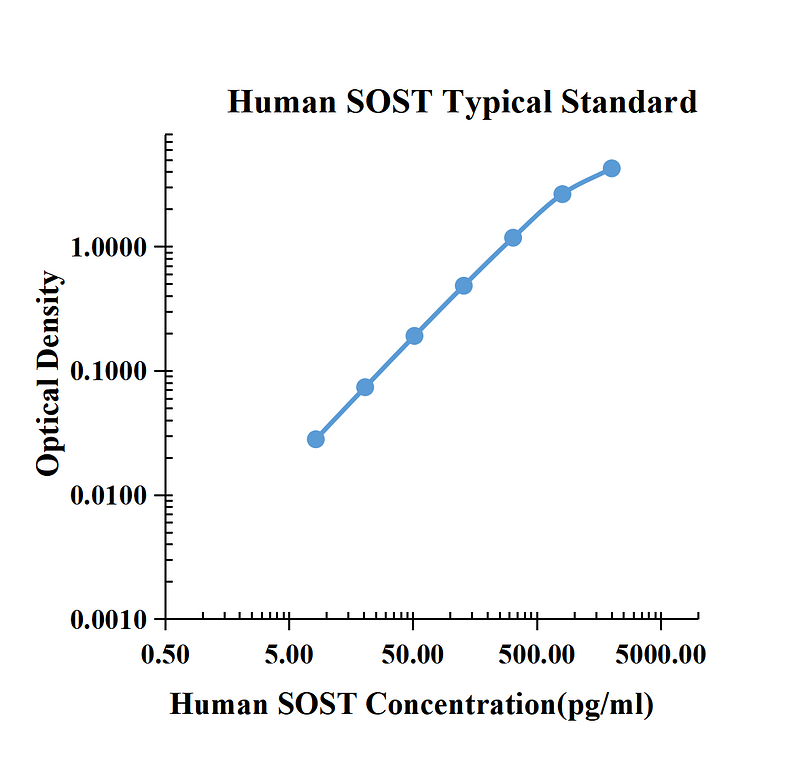
| pg/ml | O.D. | Average | Corrected | |
|---|---|---|---|---|
| 0.00 | 0.0122 | 0.0117 | 0.0120 | |
| 8.19 | 0.0403 | 0.0400 | 0.0402 | 0.0282 |
| 20.48 | 0.0871 | 0.0849 | 0.0860 | 0.0741 |
| 51.20 | 0.2017 | 0.2058 | 0.2038 | 0.1918 |
| 128.00 | 0.5116 | 0.4851 | 0.4984 | 0.4864 |
| 320.00 | 1.1817 | 1.2118 | 1.1968 | 1.1848 |
| 800.00 | 2.6924 | 2.6519 | 2.6722 | 2.6602 |
| 2000.00 | 4.2647 | 4.3375 | 4.3011 | 4.2892 |
Precision
| Intra-assay Precision | Inter-assay Precision | |||||
| Sample Number | S1 | S2 | S3 | S1 | S2 | S3 |
| 22 | 22 | 22 | 6 | 6 | 6 | |
| Average(pg/ml) | 45.4 | 206.7 | 657.6 | 44.1 | 207.5 | 653.8 |
| Standard Deviation | 1.0 | 5.8 | 16.3 | 0.9 | 8.8 | 21.5 |
| Coefficient of Variation(%) | 2.2 | 2.8 | 2.5 | 2.1 | 4.2 | 3.3 |
Intra-assay Precision (Precision within an assay) Three samples of known concentration were tested twenty-two times on one plate to assess intra-assay precision. Inter-assay Precision (Precision between assays) Three samples of known concentration were tested six times on one plate to assess intra-assay precision.
Spike Recovery
The spike recovery was evaluated by spiking 3 levels of human SOST/Sclerostin into health human serum sample. The un-spiked serum was used as blank in this experiment.
The recovery ranged from 81% to 109% with an overall mean recovery of 99%.
Sample Values
| Sample Matrix | Sample Evaluated | Range (pg/ml) | Detectable (%) | Mean of Detectable (pg/ml) |
|---|---|---|---|---|
| Serum | 30 | 26.50-325.57 | 100 | 112.33 |
Serum/Plasma – Thirty samples from apparently healthy volunteers were evaluated for the presence of human SOST/Sclerostin in this assay. No medical histories were available for the donors. n.d. = non-detectable. Samples measured below the sensitivity are considered to be non-detectable.
Product Data Sheet
Background: SOST/Sclerostin
SOST, also known as sclerostin, is a member of the cerberus/DAN family, a group of secreted glycoproteins characterized by a cysteine-knot motif. Cerberus/DAN family members are putative BMP antagonists, and include Dan, Cerberus, Gremlin, PRDC, and Caronte. While the overall sequence identity between members of the family is low, they have conserved spacing of six cysteine residues. Cerberus and Dan have an additional cysteine residue used for dimerization; however, SOST does not and is secreted as a monomer. SOST was originally identified as an important regulator of bone homeostasis. Positional cloning studies identified that mutations in the SOST gene can cause sclerosteosis and van Buchem disease, bone dysplasia disorders characterized by progressive skeletal overgrowth. Significant levels of SOST expression are detected in bone, cartilage, kidney, and liver. SOST is expressed by osteoclasts in developing bones of mouse embryos, including both intramembranously forming skull bones and endochondrally forming long bones. SOST plays a physiological role as a negative regulator of bone formation by repressing BMP-induced osteogenesis. SOST has been shown to have unique ligand specificity, binding BMP-5, -6, and -7 with high affinity and BMP-2 and -4 with low affinity. This seems to be the first example of a BMP antagonist being localized to osteoclasts, cells derived from the hematopoietic lineage, that function to degrade bone matrix. Human and mouse SOST share 88% amino acid identity.