Human Serpin A12 enzyme-linked immunoassay kit
| Specification | 96 Test |
|---|---|
| Sensitivity | 2.48 pg/ml (50 μl);19.23pg/ml (10 μl); |
| Standard Curve Range | 31.25 ~2000 pg/ml |
| Standard Curve Gradient | 7 Points |
| Number of Incubations | 2 |
| Detectable sample | Liquid phase sample of soluble substances. For example: serum, plasma, cell culture supernatant, tissue grinding liquid, etc. |
| Sample Volume | 50 μl/10 μl |
| Type | Ready-to-Use |
| Operation Duration | 120min |
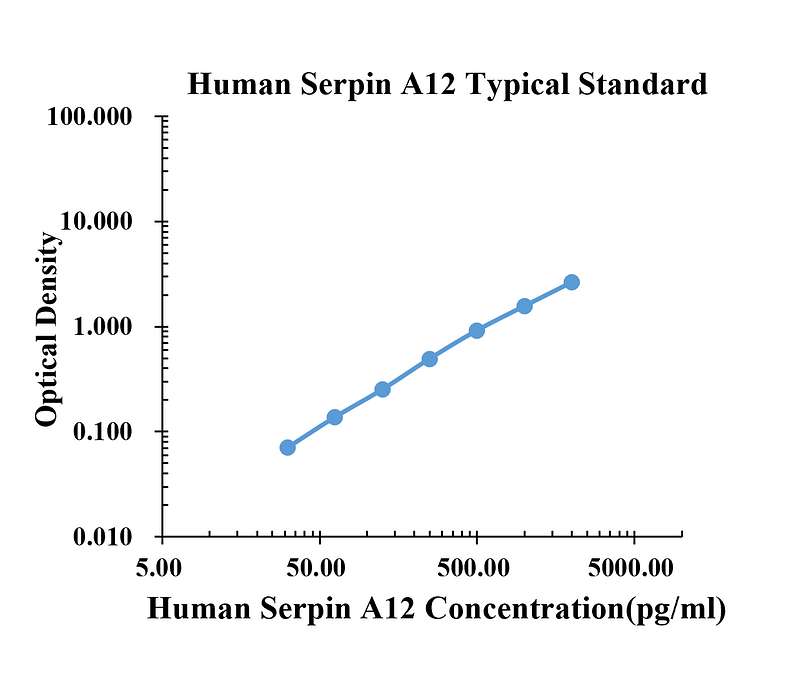
| pg/ml | O.D. | Average | Corrected | |
|---|---|---|---|---|
| 0.00 | 0.0779 | 0.0784 | 0.0782 | |
| 31.25 | 0.1476 | 0.1496 | 0.1486 | 0.0705 |
| 62.50 | 0.2088 | 0.2223 | 0.2156 | 0.1374 |
| 125.00 | 0.3183 | 0.3407 | 0.3295 | 0.2514 |
| 250.00 | 0.5592 | 0.5849 | 0.5721 | 0.4939 |
| 500.00 | 0.9686 | 1.0220 | 0.9953 | 0.9172 |
| 1000.00 | 1.5950 | 1.6860 | 1.6405 | 1.5624 |
| 2000.00 | 2.6530 | 2.7610 | 2.7070 | 2.6289 |
Precision
| Intra-assay Precision | Inter-assay Precision | |||||
| Sample Number | S1 | S2 | S3 | S1 | S2 | S3 |
| 22 | 22 | 22 | 6 | 6 | 6 | |
| Average(pg/ml) | 26.4 | 202.7 | 639.4 | 31.6 | 191.2 | 557.5 |
| Standard Deviation | 2.0 | 14.5 | 46.7 | 2.2 | 7.9 | 28.1 |
| Coefficient of Variation(%) | 7.5 | 7.1 | 7.3 | 7.0 | 4.1 | 5.0 |
Intra-assay Precision (Precision within an assay) Three samples of known concentration were tested twenty-two times on one plate to assess intra-assay precision. Inter-assay Precision (Precision between assays) Three samples of known concentration were tested six times on one plate to assess intra-assay precision.
Spike Recovery
The spike recovery was evaluated by spiking 3 levels of human Serpin A12 into health human serum sample. The un-spiked serum was used as blank in this experiment.
The recovery ranged from 70% to 95% with an overall mean recovery of 80%.
Sample Values
| Sample Matrix | Sample Evaluated | Range (pg/ml) | Detectable (%) | Mean of Detectable (pg/ml) |
|---|---|---|---|---|
| Serum | 30 | 6.64-218.03 | 100 | 48.88 |
Serum/Plasma – Thirty samples from apparently healthy volunteers were evaluated for the presence of human Serpin A12 in this assay. No medical histories were available for the donors. n.d. = non-detectable. Samples measured below the sensitivity are considered to be non-detectable.
Product Data Sheet
Background: Serpin A12
The human serpin superfamily consists of at least 35 members that target not only serine proteases, but also selected cysteine proteases and non-protease proteins. Serpins bind the protease active site resulting in a major conformational rearrangement that traps the enzyme in a covalent acyl-enzyme intermediate. As protease inhibitors, serpins have an array of functions including regulating blood clotting, the complement pathway, extracellular matrix remodeling, and cell motility. They are also involved in activities that extend beyond their ability to inhibit proteases. For instance, they may also regulate blood pressure, angiogenesis, or act as storage/transport proteins.