Human RAGE enzyme-linked immunoassay kit(one step)
| Specification | 96 Test |
|---|---|
| Sensitivity | 21.39 pg/ml (50 μl);65.37 pg/ml (10 μl); |
| Standard Curve Range | 156.25~10000 pg/ml |
| Standard Curve Gradient | 7 Points |
| Number of Incubations | 1 |
| Detectable sample | Liquid phase sample of soluble substances. For example: serum, plasma, cell culture supernatant, tissue grinding liquid, etc. |
| Sample Volume | 50 μl/10 μl |
| Type | Fully Ready-to-Use |
| Operation Duration | 90 min |
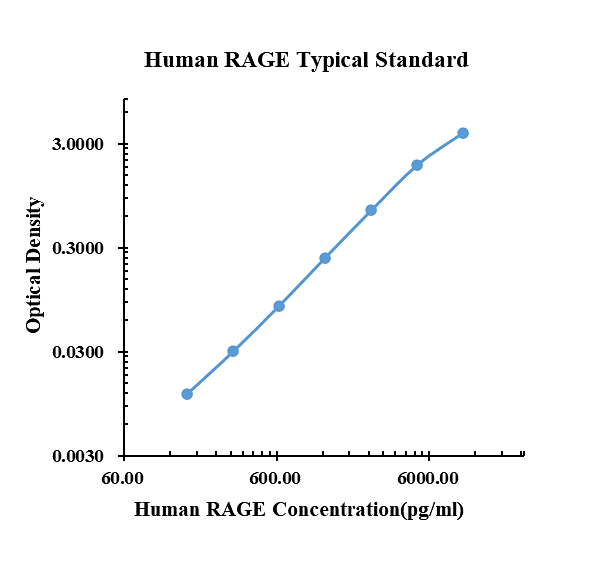
| pg/ml | O.D. | Average | Corrected | |
|---|---|---|---|---|
| 0.00 | 0.0068 | 0.0060 | 0.0064 | |
| 156.25 | 0.0178 | 0.0185 | 0.0182 | 0.0118 |
| 312.50 | 0.0346 | 0.0384 | 0.0365 | 0.0301 |
| 625.00 | 0.0884 | 0.0897 | 0.0891 | 0.0827 |
| 1250.00 | 0.2429 | 0.2499 | 0.2464 | 0.2400 |
| 2500.00 | 0.6810 | 0.6999 | 0.6905 | 0.6841 |
| 5000.00 | 1.8460 | 1.8980 | 1.8720 | 1.8656 |
| 10000.00 | 3.8120 | 3.8160 | 3.8140 | 3.8076 |
Precision
| Intra-assay Precision | Inter-assay Precision | |||||
| Sample Number | S1 | S2 | S3 | S1 | S2 | S3 |
| 22 | 22 | 22 | 6 | 6 | 6 | |
| Average(pg/ml) | 201.9 | 1011.4 | 3082.6 | 218.5 | 1013.6 | 3171.6 |
| Standard Deviation | 9.6 | 48.7 | 122.7 | 7.2 | 33.4 | 105.4 |
| Coefficient of Variation(%) | 4.8 | 4.8 | 4.0 | 3.3 | 3.3 | 3.3 |
Intra-assay Precision (Precision within an assay) Three samples of known concentration were tested Twenty-two times on one plate to assess intra-assay precision.
Inter-assay Precision (Precision between assays) Three samples of known concentration were tested six times on one plate to assess intra-assay precision.
Spike Recovery
The spike recovery was evaluated by spiking 3 levels of human RAGE into health human serum sample. The un-spiked serum was used as blank in this experiment.
The recovery ranged from 80% to 122% with an overall mean recovery of 102%.
Sample Values
| Sample Matrix | Sample Evaluated | Range (pg/ml) | Detectable (%) | Mean of Detectable (pg/ml) |
|---|---|---|---|---|
| Serum | 30 | 720.92-9110.87 | 100 | 2431.31 |
Serum/Plasma – Thirty samples from apparently healthy volunteers were evaluated for the presence of RAGE in this assay. No medical histories were available for the donors.
Product Data Sheet
Background: RAGE
RAGE (Receptor for Advanced Glycation End product) is a transmembrane glycoprotein that binds advanced glycation end products (AGEs), beta-amyloid peptides, HMGB1/Amphoterin, and several S100 family proteins. AGEs are adducts formed by the non-enzymatic glycation and oxidation of proteins and lipids. A soluble form can also be generated by MMP-mediated shedding. RAGE is expressed in the CNS during development as well as in adult endothelial cells, smooth muscle cells, pericytes, monocytes, and neurons. It is locally upregulated in vascular inflammation (e.g. diabetes, atherosclerosis, vascular injury, Alzheimer’s disease). At these sites, RAGE binding to S100A1, EN-RAGE/S100A12, or S100B induces inflammatory immune cell adhesion and infiltration as well as vascular smooth muscle proliferation, neointimal expansion, atherosclerotic plaque development, and transport of A-beta into the cerebrospinal fluid. In cancer, RAGE binding to HMGB1, S100A8, or S100A9 promotes tumor growth and metastasis in addition to inflammatory cell infiltration.