Human Neurogranin enzyme-linked immunoassay kit
| Specification | 96 Test |
|---|---|
| Sensitivity | 0.92 pg/ml (50 μl);11.03 pg/ml (10 μl); |
| Standard Curve Range | 8.19~2000 pg/ml |
| Standard Curve Gradient | 7 Points |
| Number of Incubations | 2 |
| Detectable sample | Liquid phase sample of soluble substances. For example: serum, plasma, cell culture supernatant, tissue grinding liquid, etc. |
| Sample Volume | 50 μl/10 μl |
| Type | Ready-to-Use |
| Operation Duration | 120min |
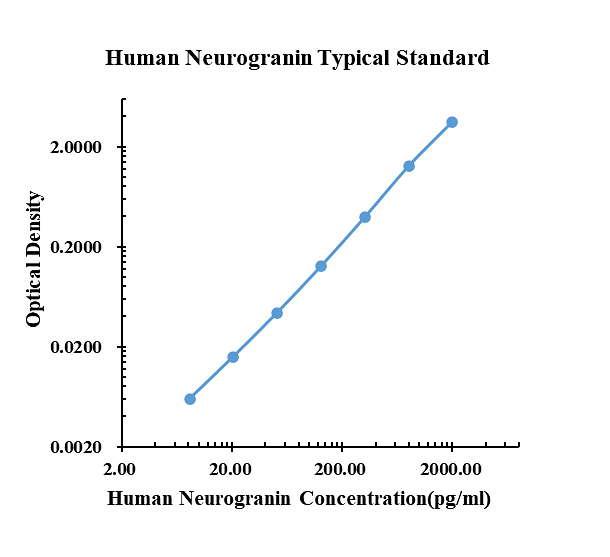
| pg/ml | O.D. | Average | Corrected | |
|---|---|---|---|---|
| 0.00 | 0.0112 | 0.0104 | 0.0108 | |
| 8.19 | 0.0162 | 0.0174 | 0.0168 | 0.0060 |
| 20.48 | 0.0261 | 0.0273 | 0.0267 | 0.0159 |
| 51.20 | 0.0538 | 0.0552 | 0.0545 | 0.0437 |
| 128.00 | 0.1319 | 0.1439 | 0.1379 | 0.1271 |
| 320.00 | 0.3888 | 0.4207 | 0.4048 | 0.3940 |
| 800.00 | 1.3030 | 1.2710 | 1.2870 | 1.2762 |
| 2000.00 | 3.5340 | 3.5620 | 3.5480 | 3.5372 |
Precision
| Intra-assay Precision | Inter-assay Precision | |||||
| Sample Number | S1 | S2 | S3 | S1 | S2 | S3 |
| 22 | 22 | 22 | 6 | 6 | 6 | |
| Average(pg/ml) | 31.3 | 163.1 | 551.2 | 35.6 | 175.0 | 570.3 |
| Standard Deviation | 1.8 | 8.7 | 23.9 | 1.5 | 5.2 | 10.0 |
| Coefficient of Variation(%) | 5.8 | 5.3 | 4.3 | 4.3 | 3.0 | 1.7 |
Intra-assay Precision (Precision within an assay) Three samples of known concentration were tested Twenty-two times on one plate to assess intra-assay precision.
Inter-assay Precision (Precision between assays) Three samples of known concentration were tested six times on one plate to assess intra-assay precision.
Spike Recovery
The spike recovery was evaluated by spiking 3 levels of human Neurogranin into health human serum sample. The un-spiked serum was used as blank in this experiment.
The recovery ranged from 80% to 119% with an overall mean recovery of 106%.
Sample Values
| Sample Matrix | Sample Evaluated | Range (pg/ml) | Detectable (%) | Mean of Detectable (pg/ml) |
|---|---|---|---|---|
| Serum | 30 | n.d.-9.44 | 67 | 2.21 |
Serum/Plasma – Thirty samples from apparently healthy volunteers were evaluated for the presence of Neurogranin in this assay. No medical histories were available for the donors.
Product Data Sheet
Background: Neurogranin
NRGN (Neurogranin/Ng; also RC3, p17 and BICKS) is a member of the neurogranin family of proteins. Although its predicted MW is 7.5 kDa, it runs anomalously at 15-19 kDa in SDS-PAGE. This is apparently due to the adoption of a rigid alpha -helical structure in a negatively charged medium. NRGN has limited expression, being found principally in excitatory neurons of the telencephalon, Golgi and Purkinje cells of the cerebellum, and platelets plus B and T cells in non-nervous tissue. Intracellularly, NRGN is found associated with membranes of the ER, Golgi and mitochondria. This association is often in the form of aggregates (or granules), thus giving rise to its name ("neuro-granules"). NRGN is also found in the nucleus and associated with the postsynaptic spines of dendrites. The principal function of NRGN appears to be the binding, sequestration and concentration of CaM (calmodulin; a Ca-binding protein) in dendritic spines. Following NMDAR activation, Ca diffuses into the synaptic area, resulting in 1) the simply dissociation of CaM from NRGN, or 2) the phosphorylation of NRGN followed by its dissociation fro CaM. In either case, the freed CaM is now available to activate multiple downstream signaling pathways, some involved in LTP (or memory). Human NRGN is 78 amino acids (aa) in length. It contains one IQ domain (aa 26-47) that binds CaM, and a collagen-like region at the C-terminus (aa 48-78). Regulatory phosphorylation occurs on Ser36, and the N-terminal Met is acetylated. Full-length human NRGN shares 96% aa sequence identity with both mouse and rat NRGN.