Human/Mouse C-Fos enzyme-linked immunoassay kit
| Specification | 96 Test |
|---|---|
| Sensitivity | 0.42 pg/ml (50 μl);0.92 pg/ml (10 μl); |
| Standard Curve Range | 1.37 ~1000 pg/ml |
| Standard Curve Gradient | 7 Points/3 Folds |
| Number of Incubations | 2 |
| Detectable sample | Liquid phase sample of soluble substances. For example: serum, plasma, cell culture supernatant, tissue grinding liquid, etc. |
| Sample Volume | 50 μl/10 μl |
| Type | Fully Ready-to-Use |
| Operation Duration | 120min |
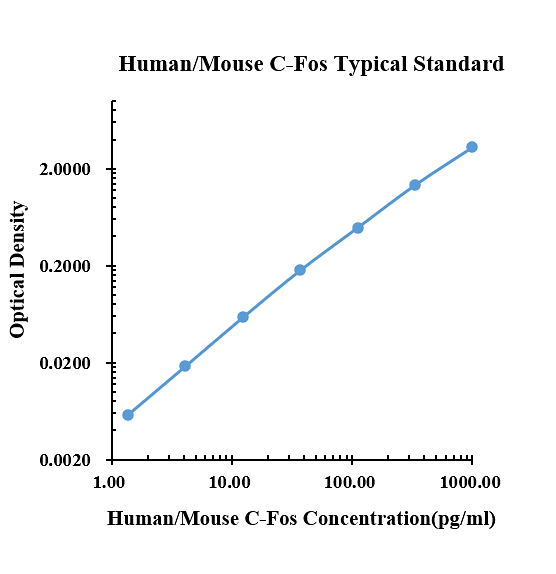
| pg/ml | O.D. | Average | Corrected | |
|---|---|---|---|---|
| 0.00 | 0.0137 | 0.0147 | 0.0142 | |
| 1.37 | 0.0205 | 0.0195 | 0.0200 | 0.0058 |
| 4.12 | 0.0329 | 0.0322 | 0.0326 | 0.0183 |
| 12.35 | 0.0713 | 0.0742 | 0.0728 | 0.0585 |
| 37.04 | 0.2012 | 0.1856 | 0.1934 | 0.1792 |
| 111.11 | 0.5080 | 0.5080 | 0.5080 | 0.4938 |
| 333.33 | 1.3790 | 1.3730 | 1.3760 | 1.3618 |
| 1000.00 | 3.4090 | 3.2950 | 3.3520 | 3.3378 |
Precision
| Intra-assay Precision | Inter-assay Precision | |||||
| Sample Number | S1 | S2 | S3 | S1 | S2 | S3 |
| 22 | 22 | 22 | 6 | 6 | 6 | |
| Average(pg/ml) | 24.1 | 112.9 | 337.4 | 23.8 | 115.5 | 326.8 |
| Standard Deviation | 0.7 | 3.8 | 8.7 | 0.3 | 4.0 | 11.7 |
| Coefficient of Variation(%) | 3.0 | 3.4 | 2.6 | 1.1 | 3.5 | 3.6 |
Intra-assay Precision (Precision within an assay) Three samples of known concentration were tested twenty-two times on one plate to assess intra-assay precision. Inter-assay Precision (Precision between assays) Three samples of known concentration were tested six times on one plate to assess intra-assay precision.
Spike Recovery
The spike recovery was evaluated by spiking 3 levels of human/mouse C-Fos into health human/mouse serum sample. The un-spiked serum was used as blank in this experiment.
The recovery ranged from 93% to 116% with an overall mean recovery of102%.
Sample Values
| Sample Matrix | Sample Evaluated | Range (pg/ml) | Detectable (%) | Mean of Detectable (pg/ml) |
|---|---|---|---|---|
| Human serum | 30 | 0.48-14.65 | 100 | 5.28 |
| Mouse serum | 30 | 0.19-121.65 | 100 | 9.33 |
Serum/Plasma – Thirty samples from apparently healthy volunteers and thirty samples from apparently healthy mice were evaluated for the presence of human/mouse C-Fos in this assay. No medical histories were available for the donors. n.d. = non-detectable. Samples measured below the sensitivity are considered to be non-detectable.
Product Data Sheet
Background: C-Fos
c-Fos is an intermediate early gene that is one of four members of the FOS family of activator protein-1 (AP-1) transcription factors, which also includes Fra-1, Fra-2, and FosB. Under the FOS gene, human c-Fos is synthesized as a protein of 308 amino acids (aa) with a basic leucine zipper (bZip) domain important for dimerization, and a basic domain for interacting with DNA, with a theoretical molecular weight of ~40.6 kDa. c-Fos can heterodimerize with members of the JUN family (c-Jun, JunB, and JunD) to form the active transcription factor AP-1 complex. AP-1 related proteins bind TPA-related responsive elements (TRE), cAMP responsive elements (CRE), and related sequences, with c-Fos:c-Jun dimers partial to TRE sites.
In response to stimuli, c-Fos, which is encoded by protooncogenes, has a role in cell proliferation, differentiation, and transformation. A variety of stimuli can increase c-Fos expression such as growth factors, proinflammatory cytokines, UV radiation, neurotransmitters, hormones, injury, and stress. c-Fos has long been used as a marker for neuronal activity and is associated with neural and behavioral responses following stimuli. Mouse studies have revealed that c-Fos is important for efficient neurogenesis and cortical development. Additionally, c-Fos signal can be used as a molecular marker for learning and memory, such as recognition and fear. Studies have found that repeated positive stimuli result in increased Fos expression while, conversely, repeated negative value stimuli are indicated by decreased signal. Intermediate early genes have also been implicated in neuropsychiatric disorders including showing altered c-Fos expression in a schizophrenia animal model. Furthermore, antipsychotics and antidepressants are both capable of impacting c-Fos expression.