Human/Monkey ESM1 enzyme-linked immunoassay kit
| Specification | 96 Test |
|---|---|
| Sensitivity | 0.25 pg/ml (50 μl);1.32 pg/ml (10 μl); |
| Standard Curve Range | 46.88 ~3000 pg/ml |
| Standard Curve Gradient | 7 Points |
| Number of Incubations | 2 |
| Detectable sample | Liquid phase sample of soluble substances. For example: serum, plasma, cell culture supernatant, tissue grinding liquid, etc. |
| Sample Volume | 50 μl/10 μl |
| Type | Fully Ready-to-Use |
| Operation Duration | 120min |
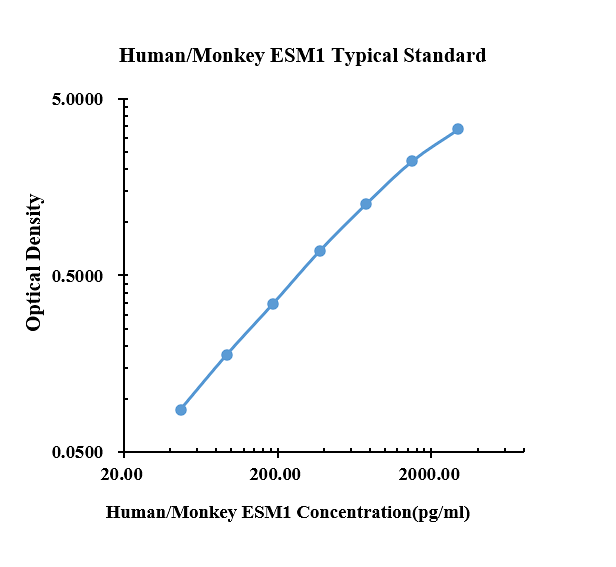
| pg/ml | O.D. | Average | Corrected | |
|---|---|---|---|---|
| 0.00 | 0.0071 | 0.0075 | 0.0073 | |
| 46.88 | 0.0949 | 0.0941 | 0.0945 | 0.0872 |
| 93.75 | 0.1887 | 0.1830 | 0.1859 | 0.1786 |
| 187.50 | 0.3645 | 0.3432 | 0.3539 | 0.3466 |
| 375.00 | 0.7057 | 0.6816 | 0.6937 | 0.6864 |
| 750.00 | 1.2880 | 1.2520 | 1.2700 | 1.2627 |
| 1500.00 | 2.2350 | 2.2110 | 2.2230 | 2.2157 |
| 3000.00 | 3.3820 | 3.3460 | 3.3640 | 3.3567 |
Precision
| Intra-assay Precision | Inter-assay Precision | |||||
| Sample Number | S1 | S2 | S3 | S1 | S2 | S3 |
| 22 | 22 | 22 | 6 | 6 | 6 | |
| Average(pg/ml) | 65.7 | 318.6 | 935.4 | 66.5 | 316.4 | 965.6 |
| Standard Deviation | 2.2 | 15.0 | 42.1 | 1.1 | 6.7 | 32.1 |
| Coefficient of Variation(%) | 3.3 | 4.7 | 4.5 | 1.7 | 2.1 | 3.3 |
Intra-assay Precision (Precision within an assay) Three samples of known concentration were tested twenty-two times on one plate to assess intra-assay precision. Inter-assay Precision (Precision between assays) Three samples of known concentration were tested six times on one plate to assess intra-assay precision.
Spike Recovery
The spike recovery was evaluated by spiking 3 levels of human/monkey ESM1 into health human/monkey serum sample. The un-spiked serum was used as blank in this experiment.
The recovery ranged from 85% to 120% with an overall mean recovery of 101%.
Sample Values
| Sample Matrix | Sample Evaluated | Range (pg/ml) | Detectable (%) | Mean of Detectable (pg/ml) |
|---|---|---|---|---|
| Human Serum | 30 | 275.37-526.45 | 100.0 | 408.94 |
| Monkey Serum | 2 | 1729.33-1900.51 | 100.0 | 1814.92 |
Serum/Plasma – Thirty samples from apparently healthy volunteers and two samples from healthy monkeys were evaluated for the presence of human/monkey ESM1 in this assay. No medical histories were available for the donors. n.d. = non-detectable. Samples measured below the sensitivity are considered to be non-detectable.
Product Data Sheet
Background: ESM1
Endocan (endothelial cell proteoglycan; also known as endothelial-cell specific molecule-1 [ESM-1]), is a 50 kDa, monomeric, secreted, cysteine-rich proteoglycan identified initially in endothelial cells of the kidney and lung. Mouse Endocan is synthesized as a 184 amino acid (aa) precursor that contains a 21 aa signal sequence and a 20 kDa, 163 aa mature region. The N-terminal 2/3 of the molecule contains 18 cysteine residues and there are no potential N-linked glycosylation sites. Based on human Endocan, there are at least two potential O-linked glycosylation sites, one of which will likely be utilized on Ser at position # 136 of the mature molecule. The posttranslational modification is approximately 30 kDa in size. It consists of a single dermatan sulfate chain that contains 4-O sulfated N-acetyl galactosamine with alpha -iduronate. This chain is suggested to bind HGF and contribute to HGF mitogenic activity. Mature mouse Endocan is 96% and 74% aa identical to rat and human Endocan, respectively. In human, there is a potential for an alternate splice variant. It shows a deletion of aa’s 82 through 131, a range which would not remove the dermatan sulfate attachment site. It is not known if such a splice form exists in mouse. Endocan is expressed by endothelial cells, adipocytes, bronchial epithelium and distal renal tubular epithelium. It is upregulated by TNF-alpha and VEGF,and is known to bind to LFA-1 ( alpha L beta 2) on the surface of PBMCs, blocking LFA-1 interaction with ICAM-1. Normal circulating levels of Endocan are approximately 1 ng/mL.