Human MCP-3/CCL7 enzyme-linked immunoassay kit
| Specification | 96 Test |
|---|---|
| Sensitivity | 10.11 pg/ml (50 μl);46.63 pg/ml (10 μl); |
| Standard Curve Range | 31.25 ~2000 pg/ml |
| Standard Curve Gradient | 7 Points |
| Number of Incubations | 2 |
| Detectable sample | Liquid phase sample of soluble substances. For example: serum, plasma, cell culture supernatant, tissue grinding liquid, etc. |
| Sample Volume | 50 μl/10 μl |
| Type | Fully Ready-to-Use |
| Operation Duration | 120min |
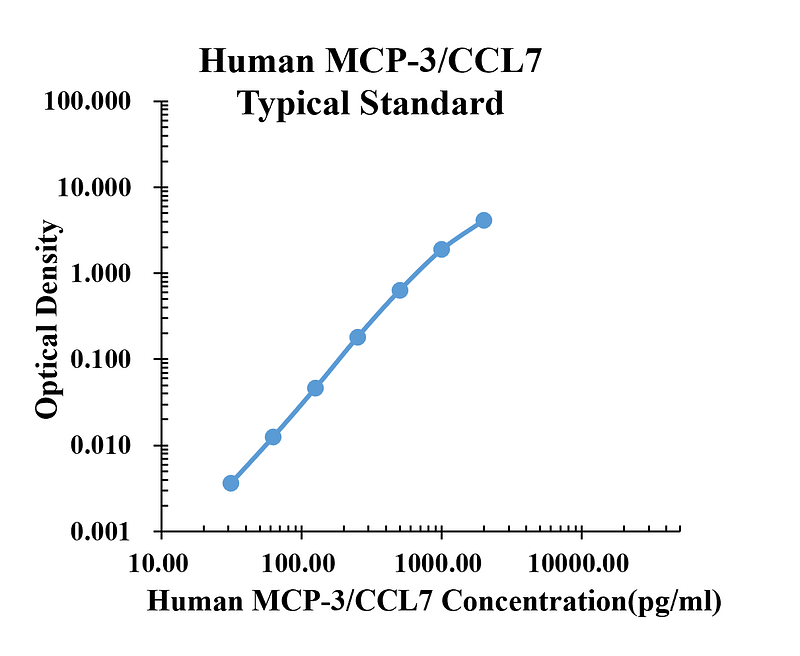
| pg/ml | O.D. | Average | Corrected | |
|---|---|---|---|---|
| 0.00 | 0.0089 | 0.0089 | 0.0089 | |
| 31.25 | 0.0127 | 0.0124 | 0.0126 | 0.0037 |
| 62.50 | 0.0223 | 0.0206 | 0.0215 | 0.0126 |
| 125.00 | 0.0541 | 0.0563 | 0.0552 | 0.0463 |
| 250.00 | 0.1972 | 0.1833 | 0.1903 | 0.1814 |
| 500.00 | 0.6470 | 0.6402 | 0.6436 | 0.6347 |
| 1000.00 | 1.9170 | 1.8810 | 1.8990 | 1.8901 |
| 2000.00 | 4.2123 | 4.0995 | 4.1559 | 4.1470 |
Precision
| Intra-assay Precision | Inter-assay Precision | |||||
| Sample Number | S1 | S2 | S3 | S1 | S2 | S3 |
| 22 | 22 | 22 | 6 | 6 | 6 | |
| Average(pg/ml) | 35.2 | 192.7 | 582.6 | 32.6 | 199.9 | 586.6 |
| Standard Deviation | 2.5 | 6.2 | 22.7 | 2.5 | 5.2 | 20.2 |
| Coefficient of Variation(%) | 7.2 | 3.2 | 3.9 | 7.6 | 2.6 | 3.5 |
Intra-assay Precision (Precision within an assay) Three samples of known concentration were tested twenty-two times on one plate to assess intra-assay precision.
Inter-assay Precision (Precision between assays) Three samples of known concentration were tested six times on one plate to assess intra-assay precision.
Spike Recovery
The spike recovery was evaluated by spiking 3 levels of human MCP-3/CCL7 into health human serum sample. The un-spiked serum was used as blank in this experiment.
The recovery ranged from 80% to 115% with an overall mean recovery of 98%.
Sample Values
| Sample Matrix | Sample Evaluated | Range (pg/ml) | Detectable (%) | Mean of Detectable (pg/ml) |
|---|---|---|---|---|
| Serum | 30 | n.d.-1134.31 | 94 | 565.01 |
Serum/Plasma – Thirty samples from apparently healthy volunteers were evaluated for the presence of human MCP-3/CCL7 in this assay. No medical histories were available for the donors. n.d. = non-detectable. Samples measured below the sensitivity are considered to be non-detectable.
Product Data Sheet
Background: MCP-3/CCL7
Mouse MARC, a member of the beta subfamily of chemokines, was initially identified as a transcript that is induced in a mouse mast cell line after Fc epsilon RI triggering by IgE plus antigen. Sequence comparisons suggest that MARC may be the mouse homologue of the human MCP-3 gene. Mouse MARC/MCP-3 expression has also been detected during murine experimental allergic encephalomyelitis in the spinal cord, and in LPS-stimulated murine WEHI -3 cells and Swiss 3T3 cells where MARC expression is glucocorticoid-attenuated. Except for one amino acid subsititution, mouse MARC is identical to mouse FIC, the product of a growth factor‑activated gene. The mouse MARC cDNA encodes a 97 amino acid residue precursor protein with a 23 amino acid residue signal peptide that is cleaved to yield a 74 amino acid residue mature protein. Mouse CCR2, a mouse chemokine receptor, has been shown to bind JE/MCP-1 with high affinity and MARC/MCP-3 with lower affinity.