Human LAG-3 enzyme-linked immunoassay kit
| Specification | 96 Test |
|---|---|
| Sensitivity | 3.40 pg/ml (50 μl) ;36.81 pg/ml (10 μl) |
| Standard Curve Range | 156.25~10000 pg/ml |
| Standard Curve Gradient | 7 Points |
| Number of Incubations | 2 |
| Detectable sample | Liquid phase sample of soluble substances. For example: serum, plasma, cell culture supernatant, tissue grinding liquid, etc. |
| Sample Volume | 50 μl/10 μl |
| Type | Ready-to-Use |
| Operation Duration | 120min |
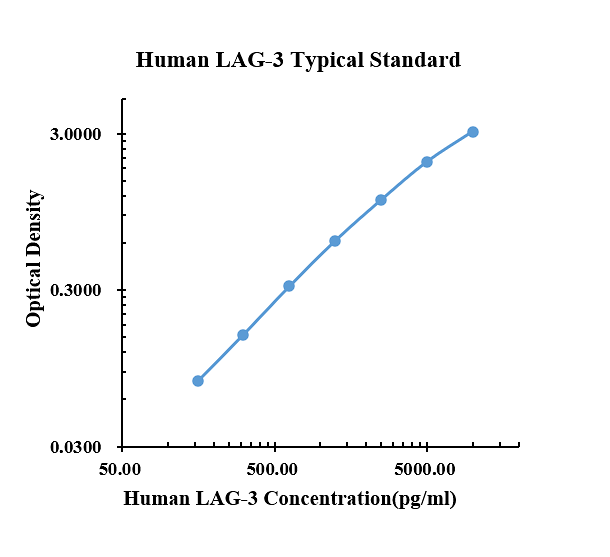
| pg/ml | O.D. | Average | Corrected | |
|---|---|---|---|---|
| 0.00 | 0.0152 | 0.0139 | 0.0139 | |
| 156.25 | 0.0949 | 0.0900 | 0.0925 | 0.0786 |
| 312.50 | 0.1725 | 0.1668 | 0.1697 | 0.1558 |
| 625.00 | 0.3285 | 0.3315 | 0.3300 | 0.3161 |
| 1250.00 | 0.6285 | 0.6328 | 0.6307 | 0.6168 |
| 2500.00 | 1.1310 | 1.1440 | 1.1375 | 1.1236 |
| 5000.00 | 1.9550 | 2.0120 | 1.9835 | 1.9696 |
| 10000.00 | 3.0790 | 3.0990 | 3.0890 | 3.0751 |
Precision
| Intra-assay Precision | Inter-assay Precision | |||||
| Sample Number | S1 | S2 | S3 | S1 | S2 | S3 |
| 22 | 22 | 22 | 6 | 6 | 6 | |
| Average(pg/ml) | 222.9 | 1049.2 | 3198.7 | 190.1 | 934.2 | 2834.4 |
| Standard Deviation | 8.9 | 31.4 | 153.4 | 7.3 | 20.1 | 92.9 |
| Coefficient of Variation(%) | 4.0 | 3.0 | 4.8 | 3.9 | 2.1 | 3.3 |
Intra-assay Precision (Precision within an assay) Three samples of known concentration were tested twenty-two times on one plate to assess intra-assay precision. Inter-assay Precision (Precision between assays) Three samples of known concentration were tested six times on one plate to assess intra-assay precision.
Spike Recovery
The spike recovery was evaluated by spiking 3 levels of human LAG-3 into health human serum sample. The un-spiked serum was used as blank in this experiment.
The recovery ranged from 81% to 118% with an overall mean recovery of 95%.
Sample Values
| Sample Matrix | Sample Evaluated | Range (pg/ml) | Detectable (%) | Mean of Detectable (pg/ml) |
|---|---|---|---|---|
| Serum | 30 | 474.27-6835.60 | 100 | 2298.95 |
Serum/Plasma – Thirty samples from apparently healthy volunteers were evaluated for the presence of human LAG-3 in this assay. No medical histories were available for the donors. n.d. = non-detectable. Samples measured below the sensitivity are considered to be non-detectable.
Product Data Sheet
Background: LAG-3
LAG-3 (Lymphocyte activation gene-3), also known as CD223, is a member of the immunoglobulin superfamily (IgSF). The mature LAG-3 protein is a 496 amino acid (aa) membrane protein with a 421 aa extracellular region which contains four IgSF domains, a 21 aa transmembrane region and a 54 aa cytoplasmic region. The extracellular domain of human and mouse LAG-3 share 69% amino acid sequence identity. LAG-3 and CD4 molecules share 20% aa sequence homology but have a similar structure. Both molecules bind to MHC class II. LAG-3 binds to MHC class II with higher affinity compared to CD4. LAG-3 is an activation-induced molecule, expressed on activated T cells and NK cells, but not on resting T cells. Studies using LAG-3 -/- mice have shown significant delay of T cell apoptosis following antigen stimulation and increased size of memory T cells pool following infection. It also has been reported that anti-LAG-3 antibodies up-regulate T cell activation by blocking interaction of LAG-3 and MHC class II. The study has demonstrated that LAG-3 is selectively expressed on activated CD4+CD25+ TReg cells and plays a role in their suppressive activity. This evidence indicated, unlike the interaction of CD4 with MHC class II that plays a positive role in T cell activation, LAG-3 binds to MHC class II and negatively regulates T cell activation through LAG-3 signaling. On the other hand, studies have shown that binding of LAG-3 to MHC class II molecules on antigen presenting cells induce maturation of dendritic cells and cytokine secretion by monocytes through MHC class II signal transduction. Taken together, LAG-3 may have two major functions, it negatively regulates T cells activation through LAG-3 signaling and stimulates antigen presenting cells which express MHC class II.