Human Galectin3 enzyme-linked immunoassay kit
| Specification | 96 Test |
|---|---|
| Sensitivity | 125.02 pg/ml (50 μl);404.56 pg/ml (10 μl); |
| Standard Curve Range | 312.50~20000 pg/ml |
| Standard Curve Gradient | 7 Points |
| Number of Incubations | 2 |
| Detectable sample | Liquid phase sample of soluble substances. For example: serum, plasma, cell culture supernatant, tissue grinding liquid, etc. |
| Sample Volume | 50 μl/10 μl |
| Type | Fully Ready-to-Use |
| Operation Duration | 120min |
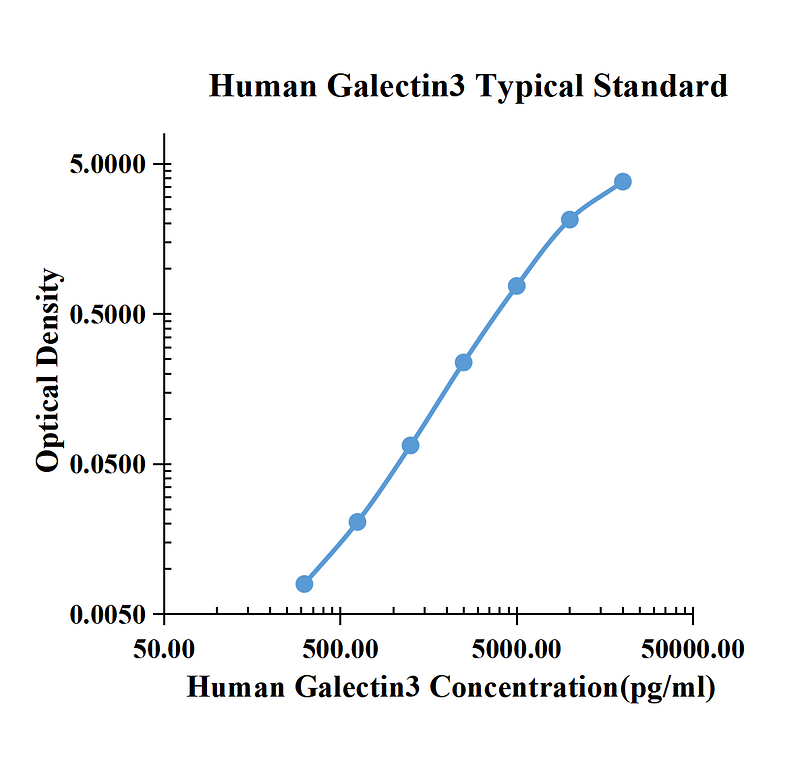
| pg/ml | O.D. | Average | Corrected | |
|---|---|---|---|---|
| 0.00 | 0.0186 | 0.0177 | 0.0182 | |
| 312.50 | 0.0266 | 0.0256 | 0.0261 | 0.0080 |
| 625.00 | 0.0389 | 0.0386 | 0.0388 | 0.0206 |
| 1250.00 | 0.0849 | 0.0847 | 0.0848 | 0.0667 |
| 2500.00 | 0.2597 | 0.2528 | 0.2563 | 0.2381 |
| 5000.00 | 0.7995 | 0.7769 | 0.7882 | 0.7701 |
| 10000.00 | 2.1670 | 2.1290 | 2.1480 | 2.1299 |
| 20000.00 | 3.8230 | 3.8410 | 3.8320 | 3.8139 |
Precision
| Intra-assay Precision | Inter-assay Precision | |||||
| Sample Number | S1 | S2 | S3 | S1 | S2 | S3 |
| 22 | 22 | 22 | 6 | 6 | 6 | |
| Average(pg/ml) | 341.7 | 1933.2 | 5656.0 | 396.7 | 1924.8 | 5724.1 |
| Standard Deviation | 25.4 | 50.6 | 153.1 | 30.8 | 36.8 | 93.0 |
| Coefficient of Variation(%) | 7.4 | 2.6 | 2.7 | 7.8 | 1.9 | 1.6 |
Intra-assay Precision (Precision within an assay) Three samples of known concentration were tested twenty-two times on one plate to assess intra-assay precision. Inter-assay Precision (Precision between assays) Three samples of known concentration were tested six times on one plate to assess intra-assay precision.
Spike Recovery
The spike recovery was evaluated by spiking 3 levels of human Galectin3 into health human serum sample. The un-spiked serum was used as blank in this experiment.
The recovery ranged from 90% to 112% with an overall mean recovery of 108%.
Sample Values
| Sample Matrix | Sample Evaluated | Range (ng/ml) | Detectable (%) | Mean of Detectable (ng/ml) |
|---|---|---|---|---|
| Serum | 30 | 60.49-135.27 | 100.0 | 93.91 |
Serum/Plasma– Thirty samples from apparently healthy volunteers were evaluated for the presence of human Galectin3 in this assay. No medical histories were available for the donors. n.d. = non-detectable. Samples measured below the sensitivity are considered to be non-detectable.
Product Data Sheet
Background: Galectin3
The galectins constitute a large family of carbohydrate-binding proteins with specificity for N-acetyl-lactosamine-containing glycoproteins. At least 14 mammalian galectins, which share structural similarities in their carbohydrate recognition domains (CRD), have been identified. The galectins have been classified into the prototype galectins (-1, -2, -5, -7, -10, -11, -13, -14), which contain one CRD and exist either as a monomer or a noncovalent homodimer; the chimera galectins (Galectin-3) containing one CRD linked to a nonlectin domain; and the tandem-repeat galectins (-4, -6, -8, -9, -12) consisting of two CRDs joined by a linker peptide. Galectins lack a classical signal peptide and can be localized to the cytosolic compartments where they have intracellular functions. However, via one or more as yet unidentified non-classical secretory pathways, galectins can also be secreted to function extracellularly. Individual members of the galectin family have different tissue distribution profiles and exhibit subtle differences in their carbohydrate-binding specificities. Each family member may preferentially bind to a unique subset of cell-surface glycoproteins.
Galectin-3, also known as Mac-2, L29, CBP35, and epsilon BP, is a chimera galectin that has a tendency to dimerize. Besides the soluble protein, alternatively spliced forms of chicken Galectin-3 containing a transmembrane-spanning domain and a leucine zipper motif have been reported. Galectin-3 is expressed in tumor cells, macrophages, activated T cells, osteoclasts, epithelial cells, and fibroblasts. It binds various matrix glycoproteins including laminin, fibronectin, LAMPS, 90K/Mac-2BP, MP20, and CEA. Galectin-3 promotes cell growth and proliferation for many cell types. Galectin-3 acts intracellularly to prevent apoptosis. Depending on the cell types, Galectin-3 exhibits pro- or anti-adhesive properties. Galectin-3 has proinflammatory activities in vitro and in vivo. It induces pro-inflammatory and inhibits Th2 type cytokine production. Galectin-3 chemoattracts monocytes and macrophages. It activates and degranulates basophils and mast cells. Elevated circulating levels of Galectin-3 has been show to correlate with the malignant potential of several types of cancer, suggesting that Galectin-3 is also involved in tumor growth and metastasis. Human and mouse Galectin-3 shares approximately 80% amino acid sequence similarity.