Human Fas/CD95/TNFRSF6 enzyme-linked immunoassay kit
| Specification | 96 Test |
|---|---|
| Sensitivity | 14.21 pg/ml (50 μl) |
| Standard Curve Range | 46.66~1000 pg/ml |
| Standard Curve Gradient | 7 Points |
| Number of Incubations | 2 |
| Detectable sample | Liquid phase sample of soluble substances. For example: serum, plasma, cell culture supernatant, tissue grinding liquid, etc. |
| Sample Volume | 50 μl |
| Type | Fully Ready-to-Use |
| Operation Duration | 120min |
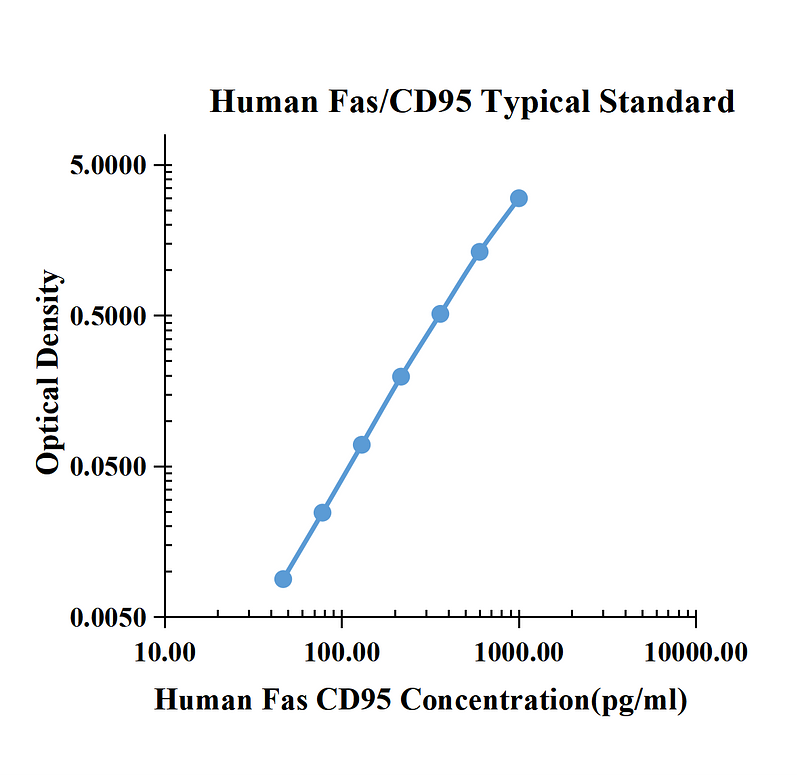
| pg/ml | O.D. | Average | Corrected | |
|---|---|---|---|---|
| 0.00 | 0.0069 | 0.0070 | 0.0070 | |
| 46.66 | 0.0162 | 0.0156 | 0.0159 | 0.0090 |
| 77.76 | 0.0302 | 0.0331 | 0.0317 | 0.0247 |
| 129.60 | 0.0750 | 0.0783 | 0.0767 | 0.0697 |
| 216.00 | 0.2002 | 0.2083 | 0.2043 | 0.1973 |
| 360.00 | 0.5135 | 0.5297 | 0.5216 | 0.5147 |
| 600.00 | 1.3260 | 1.3430 | 1.3345 | 1.3276 |
| 1000.00 | 3.0010 | 3.0360 | 3.0185 | 3.0116 |
Precision
| Intra-assay Precision | Inter-assay Precision | |||||
| Sample Number | S1 | S2 | S3 | S1 | S2 | S3 |
| 22 | 22 | 22 | 6 | 6 | 6 | |
| Average(pg/ml) | 22.3 | 111.3 | 323.8 | 21.6 | 118.3 | 345.4 |
| Standard Deviation | 1.4 | 2.3 | 6.1 | 1.6 | 3.3 | 9.2 |
| Coefficient of Variation(%) | 6.1 | 2.1 | 1.9 | 7.2 | 2.8 | 2.7 |
Intra-assay Precision (Precision within an assay) Three samples of known concentration were tested twenty-two times on one plate to assess intra-assay precision. Inter-assay Precision (Precision between assays) Three samples of known concentration were tested six times on one plate to assess intra-assay precision.
Spike Recovery
The spike recovery was evaluated by spiking 3 levels of human Fas/CD95/TNFRSF6 into health human serum sample. The un-spiked serum was used as blank in this experiment.
The recovery ranged from 90% to 122% with an overall mean recovery of 114%.
Sample Values
| Sample Matrix | Sample Evaluated | Range (pg/ml) | Detectable (%) | Mean of Detectable (pg/ml) |
|---|---|---|---|---|
| Serum | 30 | 708.03-1903.19 | 100.0 | 1101.29 |
Serum/Plasma– Thirty samples from apparently healthy volunteers were evaluated for the presence of human Fas/CD95/TNFRSF6 in this assay. No medical histories were available for the donors. n.d. = non-detectable. Samples measured below the sensitivity are considered to be non-detectable.
Product Data Sheet
Background: Fas/CD95/TNFRSF6
Tumor Necrosis Family Receptor (TNFR) superfamily member Fas, also known as CD95, APO-1, and TNFRSF6, is a 40-50 kDa type I transmembrane glycoprotein that is traditionally considered a death receptor but also functions in non-apoptotic signaling. The human Fas/TNFRSF6/CD95 protein is encoded by the FAS gene which contains 9 exons and is located on chromosome 10 (10q23.3-4). The mature canonical Fas/TNFRSF6 protein isoform is 335 aa in length, which includes the signal sequence, and has a theoretical molecular weight of 37.7 kDa. The protein contains an extracellular domain (ECD) consisting of three calcium rich domains (CRDs), a transmembrane domain (TM), and an intracellular domain (ICD) comprised of a calcium-inducing domain (CID) and characteristic dead domain (DD). The Fas protein is expressed on the plasma membrane of activated lymphocytes as a homotrimer formed via CRD1 interactions. The DD is crucial for apoptotic signaling which is triggered by the Fas receptor binding its ligand, Fas ligand (FasL). Upon Fas-FasL interaction, the DD recruits an adapter protein Fas-associated DD (FADD) and procaspase-8, generating the death-inducing signaling complex (DISC) (1-4,6-8). Formation of DISC activates caspase-8 and leads to cleavage of caspase-3, initiating a caspase-signaling cascade and cell death.
Fas-FasL-mediated apoptosis is important in immune homeostasis and removal of autoreactive T cells, autoreactive B cells, cytotoxic natural killer (NK) cells, and more. Dysfunction and mutations in the Fas receptor and the Fas-FasL signaling axis is associated a loss of apoptotic signaling and removal of autoreactive cells, which correlates with several autoimmune diseases including systemic lupus erythematosus (SLE), autoimmune lymphoproliferative syndrome (ALPS), and multiple sclerosis (MS). In addition to apoptosis and cell death signaling, FasL/TNFRSF6/CD95 mediates other pathways involved in proliferation, survival, and differentiation (3,4,6,8). More specifically, Fas has been shown to activate the NF-kappaB pathway, driving innate immunity which includes IL-1beta production and functioning in host defense. Fas is also involved in adaptive immunity playing a role in co-stimulation of CD4+ and CD8+ T cell activation as well as precocious differentiation of naive cells to effector memory T cells. Differentiation into effector memory T cells shows protection against autoimmunity but also limits antitumor response to a form of cancer immunotherapy called adoptive cell transfer (ACT). The non-apoptotic roles of the Fas/TNFRSF6/CD95 receptor highlight its potential as a target for both treating autoimmune diseases and in cancer immunotherapy.