Human EphA2 enzyme-linked immunoassay kit
| Specification | 96 Test |
|---|---|
| Sensitivity | 0.30 pg/ml (50 μl);1.23 pg/ml (10 μl); |
| Standard Curve Range | 2.74~2000 pg/ml |
| Standard Curve Gradient | 7 Points/3 Folds |
| Number of Incubations | 2 |
| Detectable sample | Liquid phase sample of soluble substances. For example: serum, plasma, cell culture supernatant, tissue grinding liquid, etc. |
| Sample Volume | 50 μl/10 μl |
| Type | Fully Ready-to-Use |
| Operation Duration | 120min |
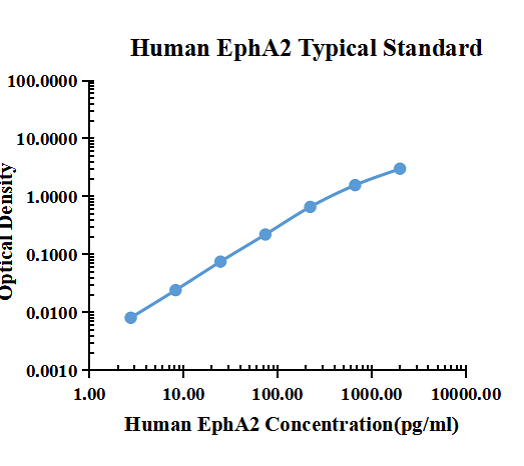
| pg/ml | O.D. | Average | Corrected | |
|---|---|---|---|---|
| 0.00 | 0.0096 | 0.0093 | 0.0095 | |
| 2.74 | 0.0181 | 0.0170 | 0.0176 | 0.0081 |
| 8.23 | 0.0356 | 0.0318 | 0.0337 | 0.0243 |
| 24.69 | 0.0857 | 0.0837 | 0.0847 | 0.0753 |
| 74.07 | 0.2362 | 0.2246 | 0.2304 | 0.2210 |
| 222.22 | 0.6780 | 0.6623 | 0.6702 | 0.6607 |
| 666.67 | 1.6000 | 1.5570 | 1.5785 | 1.5691 |
| 2000.00 | 3.0380 | 3.0070 | 3.0225 | 3.0131 |
Precision
| Intra-assay Precision | Inter-assay Precision | |||||
| Sample Number | S1 | S2 | S3 | S1 | S2 | S3 |
| 22 | 22 | 22 | 6 | 6 | 6 | |
| Average(pg/ml) | 48.5 | 221.8 | 684.9 | 40.3 | 204.8 | 657.6 |
| Standard Deviation | 3.2 | 16.2 | 29.7 | 2.9 | 5.7 | 27.7 |
| Coefficient of Variation(%) | 6.5 | 7.3 | 4.3 | 7.2 | 2.8 | 4.2 |
Intra-assay Precision (Precision within an assay) Three samples of known concentration were tested Twenty-two times on one plate to assess intra-assay precision.
Inter-assay Precision (Precision between assays) Three samples of known concentration were tested six times on one plate to assess intra-assay precision.
Spike Recovery
The spike recovery was evaluated by spiking 3 levels of human EphA2 into health human serum sample. The un-spiked serum was used as blank in this experiment.
The recovery ranged from 92% to 102% with an overall mean recovery of 96%.
Sample Values
| Sample Matrix | Sample Evaluated | Range (pg/ml) | Detectable (%) | Mean of Detectable (pg/ml) |
|---|---|---|---|---|
| Serum | 30 | 63.79-146.37 | 100 | 91.12 |
Serum/Plasma – Thirty samples from apparently healthy volunteers were evaluated for the presence of EphA2 in this assay. No medical histories were available for the donors.
Product Data Sheet
Background: EphA2
EphA2, also known as Eck, Myk2, and Sek2, is a member of the Eph receptor tyrosine kinase family which binds Ephrins A1, 2, 3, 4, and 5. A and B class Eph proteins have a common structural organization. The human EphA2 cDNA encodes a 976 amino acid (aa) precursor including a 24 aa signal sequence, a 510 aa extracellular domain (ECD), a 24 aa transmembrane segment, and a 418 aa cytoplasmic domain. The ECD contains an N-terminal globular domain, a cysteine-rich domain, and two fibronectin type III domains. The cytoplasmic domain contains a juxtamembrane motif with two tyrosine residues, which are the major autophosphorylation sites, a kinase domain, and a sterile alpha motif (SAM). The ECD of human EphA2 shares 90-94% aa sequence identity with mouse, bovine, and canine EphA2, and approximately 45% aa sequence identity with human EphA1, 3, 4, 5, 7, and 8. EphA2 becomes autophosphorylated following ligand binding and then interacts with SH2 domain-containing PI3-kinase to activate MAPK pathways. Reverse signaling is also propagated through the Ephrin ligand. Transcription of EphA2 is dependent on the expression of E-Cadherin, and can be induced by p53 family transcription factors. EphA2 is upregulated in breast, prostate, and colon cancer vascular endothelium. Its ligand, EphrinA1, is expressed by the local tumor cells. In some cases, EphA2 and EphrinA1 are expressed on the same blood vessels. EphA2 signaling cooperates with VEGF receptor signaling in promoting endothelial cell migration . The gene encoding human EphA2 maps to a region on chromosome 1 which is frequently deleted in neuroectodermal tumors.