Human DLL1 enzyme-linked immunoassay kit
| Specification | 96 Test |
|---|---|
| Sensitivity | 11.07 pg/ml (50 μl);39.33 pg/ml (10 μl); |
| Standard Curve Range | 156.25 ~10000 pg/ml |
| Standard Curve Gradient | 7 Points |
| Number of Incubations | 2 |
| Detectable sample | Liquid phase sample of soluble substances. For example: serum, plasma, cell culture supernatant, tissue grinding liquid, etc. |
| Sample Volume | 50 μl/10 μl |
| Type | Fully Ready-to-Use |
| Operation Duration | 120min |
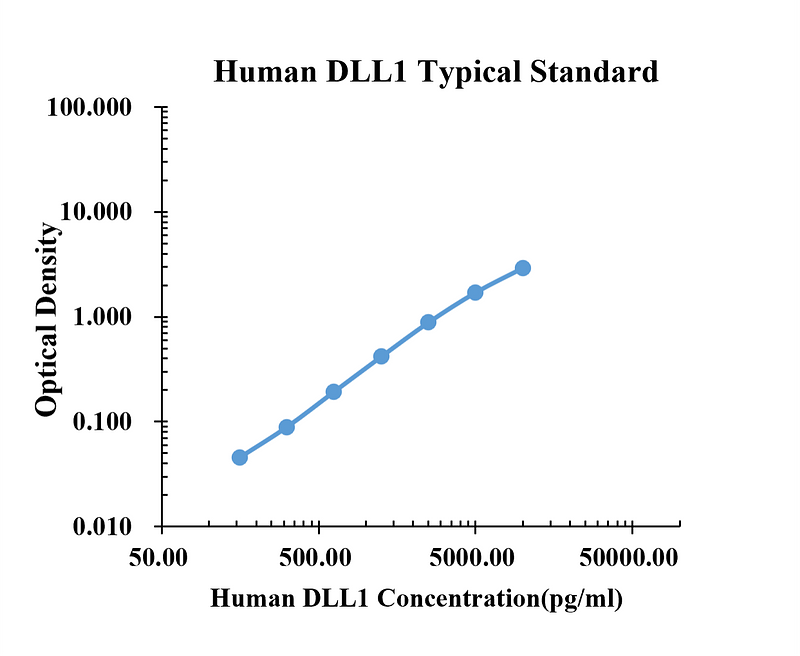
| pg/ml | O.D. | Average | Corrected | |
|---|---|---|---|---|
| 0.00 | 0.0262 | 0.0257 | 0.0260 | |
| 156.25 | 0.0730 | 0.0700 | 0.0715 | 0.0456 |
| 312.50 | 0.1135 | 0.1163 | 0.1149 | 0.0890 |
| 625.00 | 0.2173 | 0.2206 | 0.2190 | 0.1930 |
| 1250.00 | 0.4625 | 0.4238 | 0.4432 | 0.4172 |
| 2500.00 | 0.9122 | 0.9081 | 0.9102 | 0.8842 |
| 5000.00 | 1.7470 | 1.7180 | 1.7325 | 1.7066 |
| 10000.00 | 2.9250 | 2.9760 | 2.9505 | 2.9246 |
Precision
| Intra-assay Precision | Inter-assay Precision | |||||
| Sample Number | S1 | S2 | S3 | S1 | S2 | S3 |
| 22 | 22 | 22 | 6 | 6 | 6 | |
| Average(pg/ml) | 127.8 | 939.6 | 3575.8 | 140.2 | 929.3 | 3044.1 |
| Standard Deviation | 9.2 | 40.6 | 136.8 | 7.1 | 53.9 | 222.1 |
| Coefficient of Variation(%) | 7.2 | 4.3 | 3.8 | 2.4 | 2.4 | 3.8 |
Intra-assay Precision (Precision within an assay) Three samples of known concentration were tested twenty-two times on one plate to assess intra-assay precision. Inter-assay Precision (Precision between assays) Three samples of known concentration were tested six times on one plate to assess intra-assay precision.
Spike Recovery
The spike recovery was evaluated by spiking 3 levels of human DLL1 into health human serum sample. The un-spiked serum was used as blank in this experiment.
The recovery ranged from 90% to 110% with an overall mean recovery of 95%.
Sample Values
| Sample Matrix | Sample Evaluated | Range (pg/ml) | Detectable (%) | Mean of Detectable (pg/ml) |
|---|---|---|---|---|
| Serum | 30 | 2923.91-4581.01 | 100 | 3687.35 |
Serum/Plasma – Thirty samples from apparently healthy volunteers were evaluated for the presence of human DLL1 in this assay. No medical histories were available for the donors.n.d. = non-detectable. Samples measured below the sensitivity are considered to be non-detectable.
Product Data Sheet
Background: DLL1
Delta-like protein 1 (DLL1) is a 90‑100 kDa type I transmembrane protein in the Delta/Serrate/Lag-2 (DSL) family of Notch ligands. Mature mouse DLL1 consists of a 528 amino acid (aa) extracellular domain (ECD) with one DSL domain and eight EGF-like repeats, a 23 aa transmembrane segment, and a 154 aa cytoplasmic domain. Within the ECD, mouse DLL1 shares 91% and 95% aa sequence identity with human and rat DLL1, respectively. It shares 26%, 35%, and 51% aa sequence identity with DLL2, 3, and 4, respectively. A 60 kDa ECD fragment, released by ADAM9, 12, or 17 mediated proteolysis, promotes the proliferation of hematopoietic progenitor cells. The residual membrane-bound portion of DLL1 can be cleaved by presenilin-dependent gamma -secretase, enabling the cytoplasmic domain to migrate to the nucleus. DLL1 localizes to adherens junctions on neuronal processes through its association with the scaffolding protein MAGI1. DLL1 is widely expressed, and it plays an important role in embryonic somite formation, cochlear hair cell differentiation, lymphocyte differentiation, and the maintenance of neural and myogenic progenitor cells. The upregulation of DLL1 in arterial endothelial cells following injury or angiogenic stimulation is central to postnatal arteriogenesis. DLL1 is also overexpressed in cervical carcinoma and glioma and contributes to tumor progression.