Human/Monkey Clusterin enzyme-linked immunoassay kit(one step)
| Specification | 96 Test |
|---|---|
| Sensitivity | 0.14 ng/ml (10 μl) |
| Standard Curve Range | 0.01~10 μg/ml |
| Standard Curve Gradient | 7 Points/3 Folds |
| Number of Incubations | 1 |
| Detectable sample | Liquid phase sample of soluble substances. For example: serum, plasma, cell culture supernatant, tissue grinding liquid, etc. |
| Sample Volume | 50 μl/10 μl |
| Type | Ready-to-Use |
| Operation Duration | 60min |
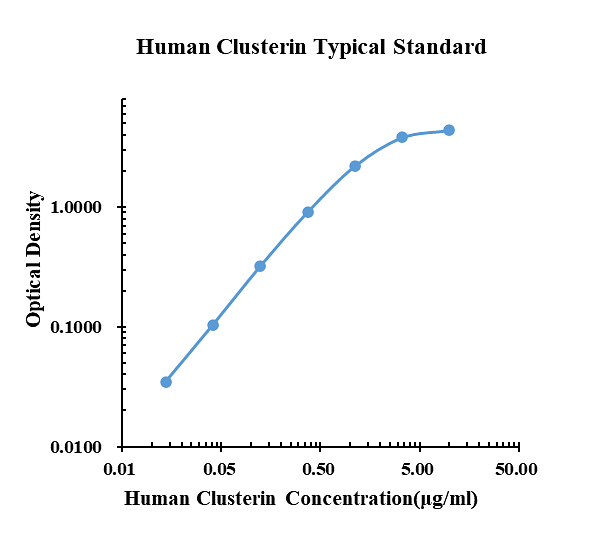
| μg/ml | O.D. | Average | Corrected | |
|---|---|---|---|---|
| 0.00 | 0.0095 | 0.0098 | 0.0097 | |
| 0.01 | 0.0453 | 0.0436 | 0.0445 | 0.0348 |
| 0.04 | 0.1151 | 0.1129 | 0.1140 | 0.1044 |
| 0.12 | 0.3329 | 0.3291 | 0.3310 | 0.3214 |
| 0.37 | 0.9104 | 0.9296 | 0.9200 | 0.9104 |
| 1.11 | 2.2030 | 2.2310 | 2.2170 | 2.2074 |
| 3.33 | 3.8400 | 3.8250 | 3.8325 | 3.8229 |
| 10.00 | 4.3491 | 4.4561 | 4.4026 | 4.3930 |
Precision
| Intra-assay Precision | Inter-assay Precision | |||||
| Sample Number | S1 | S2 | S3 | S1 | S2 | S3 |
| 22 | 22 | 22 | 6 | 6 | 6 | |
| Average(μg/ml) | 0.2 | 1.1 | 3.7 | 0.2 | 1.2 | 3.5 |
| Standard Deviation | 0.0 | 0.1 | 0.2 | 0.1 | 0.1 | 0.2 |
| Coefficient of Variation(%) | 5.1 | 5.0 | 5.3 | 5.2 | 4.9 | 5.0 |
Intra-assay Precision (Precision within an assay) Three samples of known concentration were tested Twenty-two times on one plate to assess intra-assay precision.
Inter-assay Precision (Precision between assays) Three samples of known concentration were tested six times on one plate to assess intra-assay precision.
Spike Recovery
The spike recovery was evaluated by spiking 3 levels of human Clusterin into health human serum sample. The un-spiked serum was used as blank in this experiment.
The recovery ranged from 80% to 103% with an overall mean recovery of 86%.
Sample Values
| Sample Matrix | Sample Evaluated | Range (μg/ml) | Detectable (%) | Mean of Detectable (μg/ml) |
|---|---|---|---|---|
| Human Serum | 30 | 94.12-210.07 | 100 | 142.61 |
| Monkey Serum | 2 | 96.75-108.47 | 100 | 102.61 |
Serum/Plasma – Thirty samples from apparently healthy volunteers and two samples from healthy monkeys were evaluated for the presence of human Clusterin in this assay. No medical histories were available for the donors.
n.d. = non-detectable. Samples measured below the sensitivity are considered to be non-detectable.
Product Data Sheet
Background: Clusterin
Clusterin [also known as Apolipoprotein J, Sulfated Glycoprotein 2 (SGP-2), TRPM-2, and SP-40], is a secreted multifunctional protein that was named for its ability to induce cellular clustering. It binds a wide range of molecules and may function as a chaperone of misfolded extracellular proteins. It also participates in the control of cell proliferation, apoptosis, and carcinogenesis. Clusterin is predominantly expressed in adult testis, ovary, adrenal gland, liver, heart, brain, and in many epithelial tissues during embryonic development. Human Clusterin is synthesized as a precursor that contains two coiled coil domains, three nuclear localization signals (NLS), and one heparin binding domain. Intracellular cleavages of the precursor remove the signal peptide and generate comparably sized alpha and beta chains which are secreted as an approximately 80 kDa N-glycosylated and disulfide-linked heterodimer. Mature human Clusterin shares a 77% amino acid sequence identity with mouse and rat Clusterin.
High μg/mL concentrations of Clusterin circulate predominantly as a component of high density lipoprotein particles, and these are internalized and degraded through interactions with LRP-2/Megalin. The ability of Clusterin to bind and neutralize non-oxidatively modified LDL reduces cytotoxicity in atherosclerotic plaques. The chaperone function of Clusterin helps to reduce the accumulation of beta -amyloid fibrils and damage due to amyloid plaques in Alzheimer's disease. An alternately spliced 50 kDa isoform of human Clusterin (nCLU) remains intracellular and is neither glycosylated nor cleaved into alpha and beta chains. Cellular exposure to ionizing radiation promotes the translocation of nCLU to the nucleus where it interacts with Ku70 and promotes apoptosis. This function contrasts with the cytoprotective effect of secreted Clusterin. During tumor progression, nCLU is down regulated while the secreted form is upregulated and may be aberrantly glycosylated. Increased circulating levels of Clusterin enhance tumor aggressiveness by inhibiting apoptosis and by promoting the epithelial to mesenchymal transition.