Human CD66e/CEACAM-5 enzyme-linked immunoassay kit
| Specification | 96 Test |
|---|---|
| Sensitivity | 2.60 pg/ml (50 ul) |
| Standard Curve Range | 15.63 ~1000 pg/ml |
| Standard Curve Gradient | 7 Points |
| Number of Incubations | 2 |
| Detectable sample | Liquid phase sample of soluble substances. For example: serum, plasma, cell culture supernatant, tissue grinding liquid, etc. |
| Sample Volume | 50 μl |
| Type | Fully Ready-to-Use |
| Operation Duration | 120min |
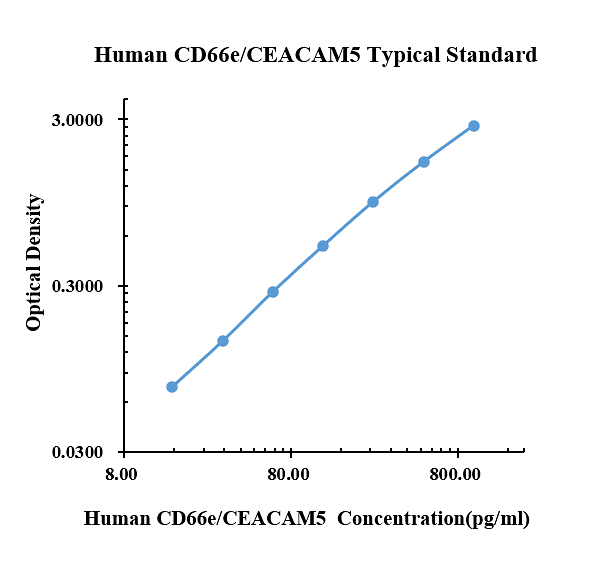
| pg/ml | O.D. | Average | Corrected | |
|---|---|---|---|---|
| 0.00 | 0.0397 | 0.0395 | 0.0396 | |
| 15.63 | 0.1158 | 0.1122 | 0.1140 | 0.0744 |
| 31.25 | 0.1874 | 0.1708 | 0.1791 | 0.1395 |
| 62.50 | 0.3159 | 0.3148 | 0.3154 | 0.2758 |
| 125.00 | 0.5713 | 0.5489 | 0.5601 | 0.5205 |
| 250.00 | 1.0140 | 0.9802 | 0.9971 | 0.9575 |
| 500.00 | 1.6900 | 1.7070 | 1.6985 | 1.6589 |
| 1000.00 | 2.8040 | 2.7650 | 2.7845 | 2.7449 |
Precision
| Intra-assay Precision | Inter-assay Precision | |||||
| Sample Number | S1 | S2 | S3 | S1 | S2 | S3 |
| 22 | 22 | 22 | 6 | 6 | 6 | |
| Average(pg/ml) | 19.1 | 99.5 | 302.4 | 22.6 | 98.6 | 275.8 |
| Standard Deviation | 1.2 | 3.8 | 12.9 | 1.0 | 3.9 | 11.3 |
| Coefficient of Variation(%) | 6.2 | 3.8 | 4.3 | 4.4 | 3.9 | 4.1 |
Intra-assay Precision (Precision within an assay) Three samples of known concentration were tested twenty-two times on one plate to assess intra-assay precision. Inter-assay Precision (Precision between assays) Three samples of known concentration were tested six times on one plate to assess intra-assay precision.
Spike Recovery
The spike recovery was evaluated by spiking 3 levels of human CD66e/CEACAM5 into health human serum sample. The un-spiked serum was used as blank in this experiment.
The recovery ranged from 99% to 115% with an overall mean recovery of 105%.
Sample Values
| Sample Matrix | Sample Evaluated | Range (pg/ml) | Detectable (%) | Mean of Detectable (pg/ml) |
|---|---|---|---|---|
| serum | 30 | 35.50-300.61 | 100.0 | 112.69 |
Serum/Plasma – Thirty samples from apparently healthy volunteers were evaluated for the presence of human CD66e/CEACAM5 in this assay. No medical histories were available for the donors. n.d. = non-detectable. Samples measured below the sensitivity are considered to be non-detectable.
Product Data Sheet
Background: CD66e/CEACAM-5
CEACAM-5, also known as CEA and CD66e, belongs to the large family of CEACAM and pregnancy specific glycoproteins. CEACAM molecules are either transmembrane or GPI-linked, and are differentially expressed between species. Orthologs of human CEACAM‑5 have not been described in other species. CEACAM-5, which is expressed primarily by epithelial cells, consists of an N-terminal Ig-like V-set domain followed by six Ig-like C2-set domains and a GPI anchor. CEACAM-5 is synthesized as a 180 kDa, variably glycosylated molecule of which approximately 60% is carbohydrate. CEACAM-5 functions as a calcium‑independent adhesion molecule through homophilic and heterophilic interactions with CEACAM-1. CEACAM-5 is restricted to the apical face of intestinal epithelial cells in the adult but is more diffuse during embryonic development and in tumors. This is consistent with a role in the development and maintenance of epithelial architecture. CEACAM-5 is upregulated in a wide variety of human tumors and is a commonly used cancer marker. It promotes tumor cell migration, invasion, adhesion, and metastasis. It also contributes to tumor formation by maintaining cellular proliferation in the presence of differentiation stimuli, and by blocking apoptosis following loss of ECM anchorage (anoikis). The GPI anchoring of CEACAM-5 can be released by GPI-PLD, resulting in a soluble molecule that also promotes tumor metastasis. Cell surface expression of CEACAM-5 on tumor cells prevents the adhesion of CEACAM-1 expressing NK cells and provides protection from NK‑mediated lysis. CEACAM-5 also binds a subset of Neisseria opacity proteins (Opa) and E. coli adhesion proteins. These interactions trigger clustering of the lipid raft-localized CEACAM-5 to sites of pathogen contact.