Human CD40 enzyme-linked immunoassay kit
| Specification | 96 Test |
|---|---|
| Sensitivity | 0.34 pg/ml (50 μl) |
| Standard Curve Range | 1.37~1000 pg/ml |
| Standard Curve Gradient | 7 Points/3 Folds |
| Number of Incubations | 2 |
| Detectable sample | Liquid phase sample of soluble substances. For example: serum, plasma, cell culture supernatant, tissue grinding liquid, etc. |
| Sample Volume | 50 μl |
| Type | Fully Ready-to-Use |
| Operation Duration | 120min |
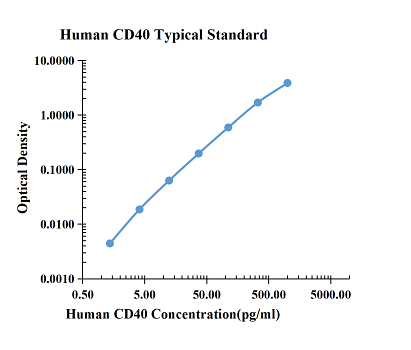
| pg/ml | O.D. | Average | Corrected | |
|---|---|---|---|---|
| 0.00 | 0.0222 | 0.0225 | 0.0224 | |
| 1.37 | 0.0257 | 0.0279 | 0.0268 | 0.0045 |
| 4.12 | 0.0406 | 0.0415 | 0.0411 | 0.0187 |
| 12.35 | 0.0851 | 0.0860 | 0.0856 | 0.0633 |
| 37.04 | 0.2245 | 0.2166 | 0.2206 | 0.1982 |
| 111.11 | 0.6181 | 0.6157 | 0.6169 | 0.5946 |
| 333.33 | 1.7090 | 1.7460 | 1.7275 | 1.7052 |
| 1000.00 | 3.8810 | 3.9440 | 3.9125 | 3.8902 |
Precision
| Intra-assay Precision | Inter-assay Precision | |||||
| Sample Number | S1 | S2 | S3 | S1 | S2 | S3 |
| 22 | 22 | 22 | 6 | 6 | 6 | |
| Average(pg/ml) | 23.6 | 121.8 | 373.3 | 23.7 | 115.7 | 342.3 |
| Standard Deviation | 0.5 | 2.8 | 8.2 | 1.0 | 3.0 | 12.5 |
| Coefficient of Variation(%) | 2.1 | 2.3 | 2.2 | 4.1 | 2.6 | 3.7 |
Intra-assay Precision (Precision within an assay) Three samples of known concentration were tested twenty-two times on one plate to assess intra-assay precision. Inter-assay Precision (Precision between assays) Three samples of known concentration were tested six times on one plate to assess intra-assay precision.
Spike Recovery
The spike recovery was evaluated by spiking 3 levels of human CD40 into health human serum sample. The un-spiked serum was used as blank in this experiment.
The recovery ranged from 91% to 121% with an overall mean recovery of 110%.
Sample Values
| Sample Matrix | Sample Evaluated | Range (pg/ml) | Detectable (%) | Mean of Detectable (pg/ml) |
|---|---|---|---|---|
| Serum | 30 | 208.10-361.52 | 100 | 281.37 |
Serum/Plasma – Thirty samples from apparently healthy volunteers were evaluated for the presence of human CD40 in this assay. No medical histories were available for the donors. n.d. = non-detectable. Samples measured below the sensitivity are considered to be non-detectable.
Product Data Sheet
Background: CD40
CD40 is a type I transmembrane glycoprotein belonging to the TNF receptor superfamily. The mature hCD40 consists of a 172 amino acid (aa) extracellular domain, a 22 aa transmembrane region and a 62 aa cytoplasmic domain. Human and mouse CD40 share 62% aa identity. CD40 is expressed in B cells, follicular dendritic cells, dendritic cells, activated monocytes, macrophages, endothelial cells, vascular smooth muscle cells, and several tumor cell lines. The extracellular domain has the cysteine-rich repeat regions, which are characteristic for many of the receptors of the TNF superfamily. Interaction of CD40 with its ligand, CD40L, leads to aggregation of CD40 molecules, which in turn interact with cytoplasmic components to initiate signaling pathways. Early studies on the CD40-CD40L system revealed its role in humoral immunity. Interaction between CD40L on T cells and CD40 on B cells stimulated B cell proliferation and provided the signal for immunoglobulin isotype switching. Mutations in the CD40L gene, which resulted in a CD40L molecule unable to interact with CD40, are responsible for the hyper-IgM syndrome. Cross-linking of CD40 with antibodies or by CD40 binding to CD40L produces cell type-specific responses which include costimulation and induction of proliferation, induction of cytokine production, rescue from apoptosis, and upregulation of adhesion molecules. Some of the early events of intracellular signaling by the
CD40‑CD40L system include the association of the CD40 with TRAFs and the activation of various kinases.