Human beta Amyloid 1-42 enzyme-linked immunoassay kit
| Specification | 96 Test |
|---|---|
| Sensitivity | 3.15 pg/ml (50 μl);6.07 pg/ml (10 μl) |
| Standard Curve Range | 7.81~500 pg/ml |
| Standard Curve Gradient | 7 Points |
| Number of Incubations | 2 |
| Detectable sample | Liquid phase sample of soluble substances. For example: serum, plasma, cell culture supernatant, tissue grinding liquid, etc. |
| Sample Volume | 50 μl/10 μl |
| Type | Ready-to-Use |
| Operation Duration | 120min |
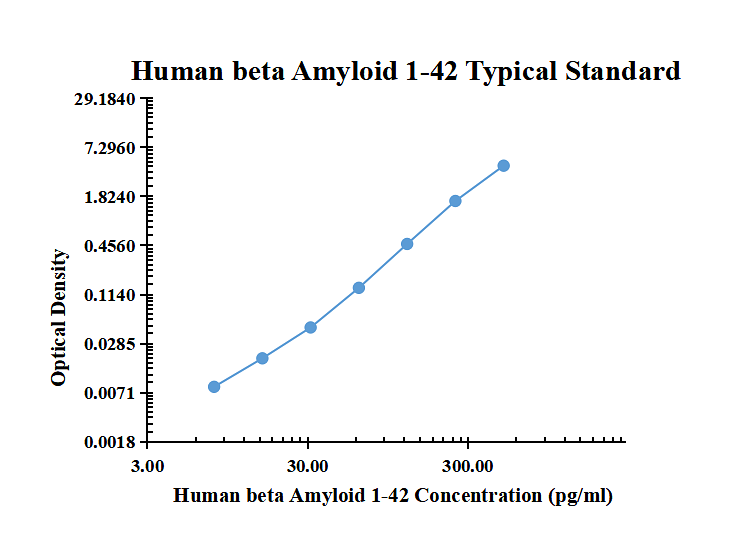
| pg/ml | O.D. | Average | Corrected | |
|---|---|---|---|---|
| 0.00 | 0.0377 | 0.0408 | 0.0393 | |
| 7.81 | 0.0472 | 0.0481 | 0.0477 | 0.0084 |
| 15.63 | 0.0538 | 0.0523 | 0.0531 | 0.0138 |
| 31.25 | 0.0635 | 0.0649 | 0.0642 | 0.0250 |
| 62.50 | 0.1532 | 0.1409 | 0.1471 | 0.1078 |
| 125.00 | 0.5310 | 0.4995 | 0.5153 | 0.4760 |
| 250.00 | 1.7136 | 1.5701 | 1.6419 | 1.6026 |
| 500.00 | 4.3511 | 4.2184 | 4.2848 | 4.2455 |
Precision
| Intra-assay Precision | Inter-assay Precision | |||||
| Sample Number | S1 | S2 | S3 | S1 | S2 | S3 |
| 22 | 22 | 22 | 6 | 6 | 6 | |
| Average(pg/ml) | 11.3 | 48.3 | 149.0 | 10.2 | 52.0 | 153.6 |
| Standard Deviation | 0.8 | 1.2 | 4.8 | 0.6 | 2.8 | 8.2 |
| Coefficient of Variation(%) | 6.8 | 2.4 | 3.2 | 5.9 | 5.4 | 5.4 |
Intra-assay Precision (Precision within an assay) Three samples of known concentration were tested Twenty-two times on one plate to assess intra-assay precision.
Inter-assay Precision (Precision between assays) Three samples of known concentration were tested six times on one plate to assess intra-assay precision.
Spike Recovery
The spike recovery was evaluated by spiking 3 levels of human beta Amyloid 1-42 into health human brain tissue sample. The un-spiked brain tissue was used as blank in this experiment.
The recovery ranged from 81% to 112% with an overall mean recovery of 95%.
Sample Values
| Sample Matrix | Sample Evaluated | Range (pg/ml) | Detectable (%) | Mean of Detectable (pg/ml) |
|---|---|---|---|---|
| Brain tissue | 30 | 51.78-57.51 | 100 | 53.56 |
Brain tissue – Thirty samples from apparently healthy volunteers were evaluated for the presence of beta Amyloid 1-42 in this assay. No medical histories were available for the donors.
Product Data Sheet
Background: beta Amyloid 1-42
Amyloid Precursor Protein (APP) is a type I transmembrane protein that is ubiquitously expressed on cell surfaces. It undergoes complex proteolytic processing and is cleaved by alpha-, beta-, and gamma-Secretases to generate soluble APP alpha, soluble APP beta, and Amyloid beta (A beta) fragments of several lengths. One of these fragments, A beta 42, generated by beta- and gamma-Secretase activities, has been implicated in Alzheimer's disease. Aberrantly high levels of this peptide form and accumulate in the brains of Alzheimer's disease patients to create the senile plaques characteristic of the disease.