Human CD254/RANKL/TNFSF11 ELISA Kit检测试剂盒
| 规格 | 96 Test |
|---|---|
| 灵敏度 | 0.20 pg/ml (50 μl);0.76 pg/ml (10 μl); |
| 标准曲线范围 | 6.86~5000 pg/ml |
| 标准曲线梯度 | 7点/3倍 |
| 孵育次数 | 2 |
| 可检测样本 | 可溶性物质的液相样品。例如:血清,血浆,细胞培养上清,组织研磨液等。 |
| 加样体积 | 50 μl/10 μl |
| 类型 | 完全即用型 |
| 操作时长 | 120min |
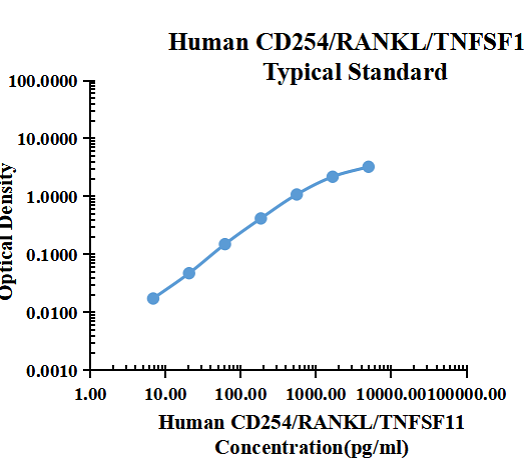
| pg/ml | O.D. | Average | Corrected | |
|---|---|---|---|---|
| 0.00 | 0.0113 | 0.0117 | 0.0115 | |
| 6.86 | 0.0282 | 0.0296 | 0.0289 | 0.0174 |
| 20.58 | 0.0583 | 0.0597 | 0.0590 | 0.0475 |
| 61.73 | 0.1615 | 0.1627 | 0.1621 | 0.1506 |
| 185.19 | 0.4068 | 0.4528 | 0.4298 | 0.4183 |
| 555.56 | 1.0560 | 1.1330 | 1.0945 | 1.0830 |
| 1666.67 | 2.2150 | 2.1870 | 2.2010 | 2.1895 |
| 5000.00 | 3.2400 | 3.2890 | 3.2645 | 3.2530 |
精度
| Intra-assay Precision | Inter-assay Precision | |||||
| Sample Number | S1 | S2 | S3 | S1 | S2 | S3 |
| 22 | 22 | 22 | 6 | 6 | 6 | |
| Average(pg/ml) | 98.6 | 567.8 | 1800.9 | 81.2 | 446.1 | 1484.8 |
| Standard Deviation | 5.2 | 41.2 | 140.4 | 3.2 | 13.9 | 70.5 |
| Coefficient of Variation(%) | 5.3 | 7.3 | 7.8 | 3.9 | 3.1 | 4.7 |
板内精密度:3 个已知浓度的样本酶标板内重复测定 22 次,评估酶标板内的精密度。
板间精密度:3 个已知浓度的样本酶标板间重复检测 6 次,评估酶标板间的精密度。
加标回收
健康人血清加入 3 个不同浓度水平的人 CD254/RANKL/TNFSF11 ,未加人 CD254/RANKL/TNFSF11 的血清作为本底,计算回收率。回收率的范围从 80 % 至 102 %,平均回收率为 91%。
样本值
| Sample Matrix | Sample Evaluated | Range (pg/ml) | Detectable (%) | Mean of Detectable (pg/ml) |
|---|---|---|---|---|
| Serum | 30 | 0.63-9.14 | 100 | 4.14 |
应用本试剂盒,检测 30 个健康志愿者的血清样本,志愿者的用药史不详。n.d. = 测不到浓度值。样本的浓度值低于灵敏度被认为测不到浓度值。
产品数据表
背景: CD254/RANKL/TNFSF11
RANKL (TNFSF11) 是一种 II 型跨膜蛋白,是 NF-κB (RANK) 受体的配体。RANKL 是 NF-κB 的激活剂。RANKL 可与 NF-κB 结合并诱导单核细胞/巨噬细胞谱系细胞分化为破骨细胞,进一步导致破骨细胞前体成熟。因此,RANKL 对于破骨细胞成熟、骨骼建模和骨骼重塑,以及淋巴结 (LN) 的发育至关重要。在骨组织中,RANKL 由成骨细胞、骨细胞和免疫细胞表达,尤其是成骨细胞和骨细胞中。人 RANKL 与小鼠和大鼠的氨基酸同源性分别为 82.02% 和 84.44%。小鼠 RANKL 与大鼠的氨基酸同源性为 94.94%。人 RANKL 由细胞质结构域 (M1-S47)、螺旋结构域 (M48-F68) 和细胞外结构域 (Y69-D317) 组成。可溶性片段 (140-317) 在被基质金属蛋白酶 (MMP3 或 7) 和 ADAM 等酶切割后可被释放。